Anvilbrow - The Triceratops

Anvilbrow - The Triceratops

You will hear it grazing a mile off. Turn the wagons then, not when you can see the frill.

Rich

Role in Its Society

An anvilbrow does not hunt, stalk, or ambush anything. It eats, it walks, and it turns the Ashen Plains over one furrow at a time — and that single habit makes it the most consequential animal on the flats.

The plains are a desert made of dust rather than sand. Centuries of ash lie drifted over the basalt in soft grey dunes, and almost nothing green survives on top of it. What survives is underneath it: ashblight moss clinging to buried stone, scorched sedge rooted deep enough to hold, ember thorns whose sap-filled needles glow faintly beneath a foot of soot. An anvilbrow reaches all of it. It walks with its head low and its beak angled down like a plough-share, and it shoulders through the drift in long, patient passes, throwing up a chest-high wake of ash on either side and leaving behind a furrow of exposed, damp, dark ground.

Everything else on the plains has learned to follow that furrow. Firewing flocks drop in behind a moving herd to pick over what gets turned up. Flame wasps nest along the churn line. Glass vipers hunt the edges where the ash wall meets bare rock. Even the ash-camouflaged predators that rule the flats keep a careful, respectful distance from a grown anvilbrow — a lone ambush hunter can take a straggling calf on the herd's outside edge, and does, but a plains cat that commits to an adult gets exactly one chance to learn it was a mistake. The furrow is the other reason those predators resent a herd's presence: a stretch of plain that has been ploughed is a stretch of plain with no ash left to hide in.

To Ash'rift, the anvilbrow is two things at once, and the settlement has never entirely settled on which matters more. It is the reason the northern trade road has to be re-cut every few seasons. It is also the source of the finest raw material the smiths get for free.

Appearance Description

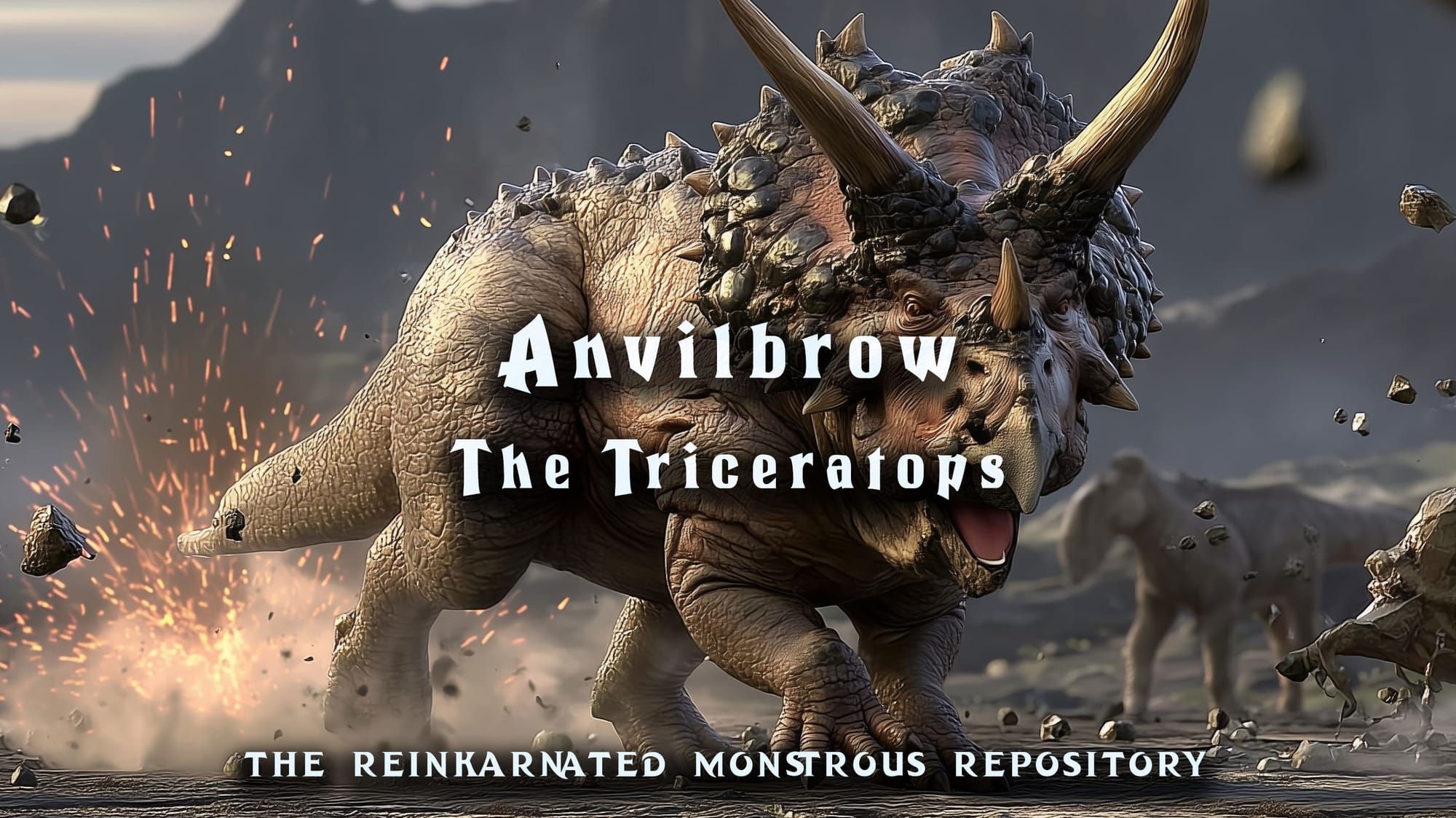
Start with the frill. An anvilbrow's head-shield is a broad, blunt, forward-canted slab of bone as wide as a wagon is long, and by the time the animal is full-grown that bone is buried under something else entirely: a thick, lumpy, layered crust of fused volcanic glass. Years of shoving a bony face through hot grit near the mountain skirts, of grazing ground that still radiates heat, of walking through ashfall that has not finished cooling — all of it accretes, melts thin, and hardens again into a knobbled armour of black and bottle-green slag. Ash'rift smiths call the stuff clinker-plate. It sits heaviest across the frill and the shoulders and thins along the flanks, so a bull in good condition looks like it is wearing a mismatched suit of somebody else's armour, badly and permanently welded on.

Beneath the crust the animal is a dull, dusty brick-red, the colour of cooled lava rather than blood. Three horns: two long brow-horns that curve forward and slightly inward, worn blunt and shining at the tips from a lifetime of use as digging tools, and a shorter nose-horn that is more chisel than spike. The beak is enormous and hooked and, in an old bull, chipped like a much-used adze.

It stands about eleven feet at the shoulder and moves with the flat, unhurried gait of something that has never in its life needed to be anywhere quickly. On cold mornings the clinker-plate steams — heat held overnight in all that glass, bleeding off into the grey air — and a whole herd at dawn looks like a low range of hills that has started to smoke.

Backstory

Nobody in Ash'rift can tell you when the herds first came down onto the ash, and nobody has ever much cared to work it out. The anvilbrow is simply part of the plains, the way the ashfall is part of the plains: an old, slow, enormous fact that predates anyone's grandmother and will outlast anyone's grandchild.

What the smiths can tell you, in detail, is what the animal is worth. An anvilbrow sheds. Every Ashen Season, as the heavy fall thickens and the herds press up toward the mountain skirts where the ash lies thinner, the outermost layer of clinker-plate loosens, cracks along its own stress lines, and comes away in curved sheets and jagged wedges. The herd leaves them behind in the churn. What is left underneath is a fresh raw surface that will glaze over again within a season, which means the same animal produces the same harvest year after year, indefinitely, without anyone having to kill it.

That shed plate is a genuinely good material. It is glass that the plains themselves have already quenched, cracked, and re-fused a hundred times over — the ash-tempered steelwork Ash'rift is famous for owes a real debt to whoever first thought to gather it. Crews go out along the churn lines during the shed, walking the furrows with hooked poles and hide sacks, and they come back with panniers full of black slag wedges that never cost a single blow to win. It is one of the very few things in Emberfall that the mountain simply hands over.

Which is not the same as saying it is easy. The herds are on the move during the shed. They range unpredictably. They do not object to being followed, and they do not object to being gathered from — an anvilbrow is placid to the point of appearing bored — right up until something gets between a cow and her calf, or until a crew makes the specific mistake of standing in the furrow rather than beside it. Ash'rift has buried gatherers. It keeps doing the work anyway, because Grorik Embermaw's own reasoning applies here as neatly as it applies to anything else in that settlement: the plains offer a hard bargain, and taking a hard bargain well is most of what worth is.

🛡 A fine map and a stout companion await. Access all character scrolls and battlefields for just $5 a month. Join the Local Heroes!

Check out the available ranks
📝 Join the Guild!
🔐 Already have an account? Return to the Guildhall Log in