Cinderback - The Giant Ape
He stands, drums his chest, and fills the air with orange dust. That is the warning. Everything after it is a choice somebody made.

Role in Its Society
The cinderback has a society, which is more than most of the Verdant Shroud can claim, and the Shroud has been quietly depending on it for longer than anyone has bothered to notice.
South of Cinderglade, where the hill-chains close in and the long-cooled lava flows disappear under a hundred feet of green, the Shroud does something no other part of Emberfall manages: it grows back faster than the mountain can burn it. Ash-fed soil pulses with life there. Bioluminescent beds light the underbrush after dark. Ancient roots split blackened stone open and keep going. Everyone who has ever walked into that valley comes out talking about the Emberheart, or the Burnwake Pools, or the sheer noise of the place at night. Almost nobody comes out talking about the wide grey shapes moving through the undergrowth alongside them, because a cinderback troop travels at a walk, on its knuckles, below the line of the ferns, and it does not want to be found any more than it wants to be fought.
A troop is eight or ten animals with one enormous male at the front of it: a broad, silver-mantled bull whose back carries so much rooted growth that from behind he reads as a moving hillside. Behind him are females, juveniles, and usually an infant riding somebody's shoulders with both fists in the moss. They eat emberpetal flowers, firewillow leaves, and whole hanging curtains of ash-bloom vine, they eat for most of the day, and they walk perhaps a mile while doing it. Every night they stop wherever they happen to be, tear down an armful of vine each, and build a bowl-shaped nest on the ground to sleep in. The next morning they abandon it and never use it again.
That habit is how the Shroud spreads. Every animal in the troop is carrying a coat — a dense mat of cindermoss, glowing fungus and rooted vine growing directly out of its fur, kept alive by the animal's own smouldering skin and shot through with the fine orange spores that give the creature its name. Feeding shakes it loose. Walking shakes it loose. Sleeping in a fresh nest packs a season's worth of it into the ground in a single night. A troop leaves a line of abandoned nests behind it like stitches, and every one of them is a seedbed. Follow a cinderback trail backward far enough and you are walking through the richest, greenest, fastest-growing ground in the valley, planted by animals that have no idea they are doing it.
The plainsrunners of Cinderglade are the only people who have made a working arrangement with them, and it is mostly an arrangement about distance. Herders track a troop's line of night nests and harvest the abandoned ones, raking the spore-felt out of the bedding before the rain takes it — no contact, no risk, and the animals never even know they were followed. A very few herders, the ones who have spent years being tolerated, are permitted closer than that: they sit down at the edge of a feeding troop, wait to be ignored, and comb a season's growth off a resting flank with a wide wooden rake. Never a blade. Never with a lantern. Never in a hurry. The felt is cured over a low fire and worked into some of the finest fire-touched cloth that leaves the enclave.
Everyone else in Emberfall who has heard of a cinderback has heard of it as a warning, and the warning is never about being bitten. It is about torches.
Appearance Description
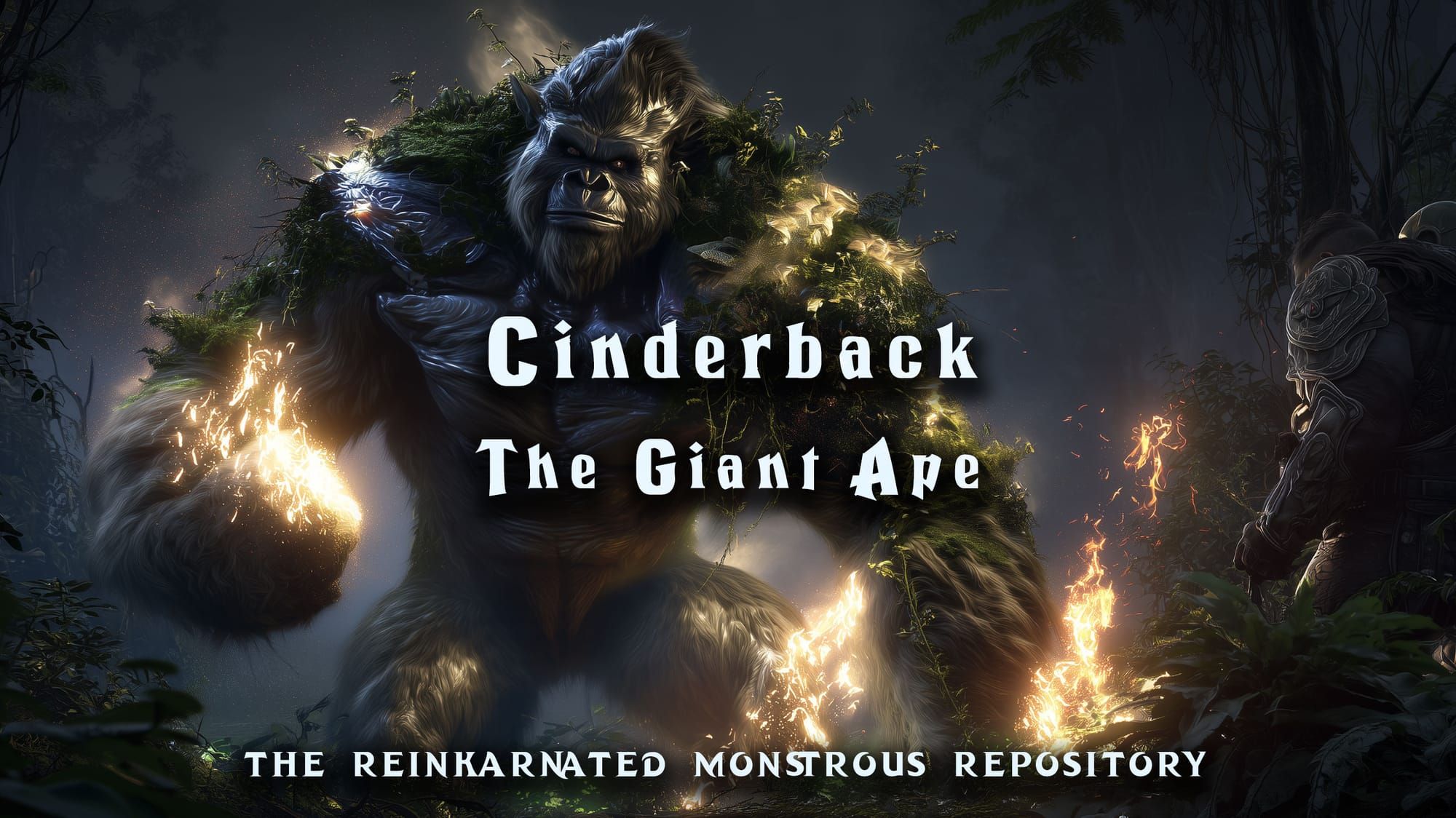
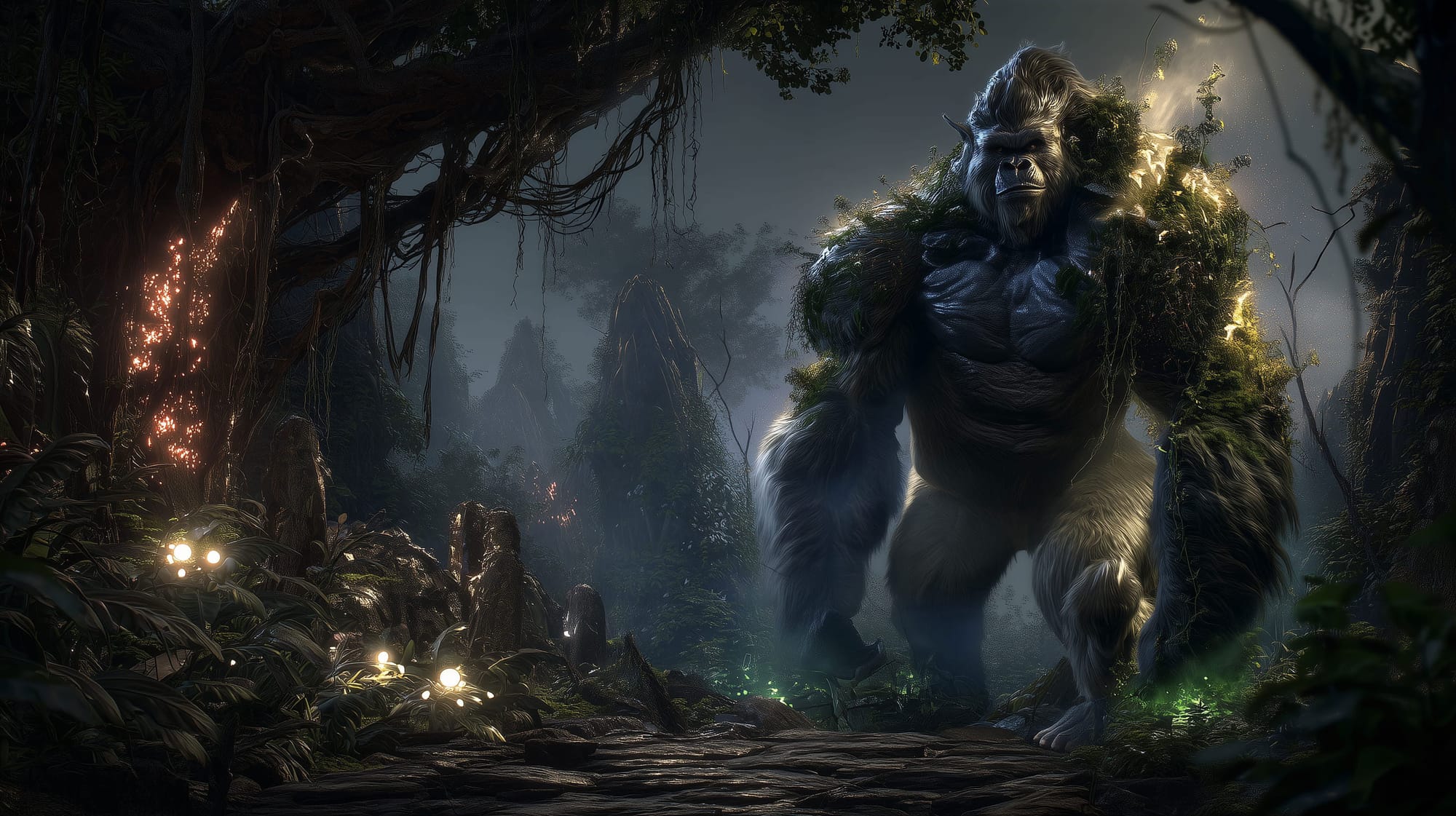
Start with the bull, because he is the thing every account gets wrong. A full-grown male cinderback stands nearly six feet at the shoulder on all fours and half again that when he rises, and he weighs more than a loaded handcart. He walks on the knuckles of both hands, which are the size of dinner plates and worn smooth and black as river stone. His chest is the widest part of him by a considerable margin. His arms are longer than his legs, thick as a barrel through the forearm, and there is nothing decorative about any of it.
The fur underneath is coarse, grey-brown and grooved along every hair — thousands of tiny channels that hold water, ash and spore alike. Across the shoulders and down the back of a mature male it runs silver, and on that silver saddle almost nothing of the animal is visible at all. What you see there is the coat: a layered, living mantle of cindermoss and ash-bloom vine, threaded through with pale fungus that glows soft green after dark, so that a bull bedded down in the undergrowth looks like a mossy boulder somebody has rolled into the ferns. Firefinches work his shoulders for insects. Beetles live in him. A grown animal carries an entire hillside on his back and has been doing it for years.
The skin beneath all of that is warm — genuinely, unpleasantly warm, running hot enough that rain steams off his back and the coat never truly dries. That heat is where the spores come from. They are fine, gritty and a dull orange, they smell like a forge yard, and they hang suspended in the air around the animal in a haze so faint that most people mistake it for light coming through the leaves. Get close enough and you will taste them at the back of your throat before you see them.
The face is broad, black and startlingly expressive, with a heavy brow, a crested skull and small deep-set eyes that watch you far more carefully than you are watching them. The hands are the exception to everything gentle about him. They are long-fingered, precise enough to strip a single emberpetal blossom off its stem without bruising the leaf beside it, and strong enough to pull a firewillow branch out of a tree the way a person pulls a weed. They are not weapons. They will absolutely serve as weapons.
Backstory
The cinderback is not the product of any calamity. Nothing made it. It is simply what a large leaf-eating climber becomes after enough generations in a valley that grows back faster than anything can eat it.
Hurry is a cost, and the Shroud does not charge it. There is food in every direction, at every height, in both the Lush Season and the Ashen. Nothing in that valley has to compete for a meal, and an animal that never has to race anything to breakfast has no reason to spend its life at speed. So the cinderback came down out of the branches, where the food is thinner and the climb is expensive, and took up the ground instead — walking its whole range on its knuckles, eating everything at eye level, climbing only when it wants a crown of ash-bloom nobody else can reach. It is an unhurried animal, and it has been unhurried for a very long time, and people make an assumption about that which has killed several of them. An animal that never needs to hurry is not the same thing as an animal that cannot. When a cinderback decides to cross forty feet of ground, it is already there.
What it built instead of speed was the coat. Warm skin in a wet valley grows things, and what began as a nuisance — moss taking hold in grooved fur that never dries — became the animal's whole defence, because everything that grows in the Shroud is fire-adapted, and everything the Shroud's heat produces eventually produces spores. A cinderback's coat is a slow, permanent, low-grade smoulder, held just below the point of ignition by the moisture of the growth sitting on top of it. Something that bites into it gets a mouthful of gritty heat and burning eyes. Something that persists gets considerably worse. Whatever hunts the deep Shroud worked this out a very long time ago and has, on the whole, decided that a troop of them is not worth the afternoon.
What it built alongside the coat was the warning. A cinderback bull has no interest in a fight he can end before it starts, and he has an entire vocabulary for ending them. He rises. He tears an armful of vine out of the ground and throws it. He hammers the flat of both hands against his own chest — and the sound of that carries a quarter-mile through wet air, and the dust that comes off him when he does it turns the whole clearing orange. He slaps the ground. He runs at you and stops. Every one of those is a sentence, every one of them means the same thing, and any creature in the Shroud that has met a troop before understands all of them perfectly. The display is not a bluff in the sense of being empty. It is a bluff in the sense that he would genuinely rather not.
Which leaves fire. The one thing a cinderback's defence cannot handle is a defence exactly like its own, arriving faster. Open flame within a few feet of a grown animal does not singe it — the bull barely notices — but it flashes the suspended spore haze all at once, and everything standing in that haze is suddenly standing in the middle of a very brief, very enthusiastic fire. Worse, the display makes it likelier: a bull who is warning you off is beating fresh clouds of the stuff into the air with every strike of his hands. This has happened to enough foragers, often enough, that in the Shroud the two facts are taught as one sentence: he is telling you to leave, put the torch out.
Cinderglade's herders have one story about the animal that they will not tell cheerfully, and it is not about burns. A troop that fed beneath the Emberheart for as long as any living plainsrunner could remember is no longer beneath the Emberheart. The bull took them off that range entirely, walked them across open ground in daylight with an infant on a female's shoulders, and settled three ridges away. He has not gone back. Nobody has an explanation, and nobody is comfortable offering one, because a silverback does not abandon good feeding, and he does not walk his young across open country, for a small reason.