Coldbrand - The Tyrannosaurus Rex
Everything alive in the Verdant Shroud carries a little light. The coldbrand is the hole in it, and by the time you understand what you are looking at, you are already standing inside its reach.
Role in Its Society
The Verdant Shroud is the one stretch of Emberfall that gives back more than the mountain takes. Ash-fed soil pulses with growth there, ancient roots crack the old blackened stone apart to get at it, and after dark the whole understory comes up in a soft cold light — glowing fungus beds along the root mats, emberpetal flowers open on the low ground, ash-bloom vines threading the firewillows overhead. Nothing in the Shroud navigates by sight the way a creature does anywhere else. Everything in the Shroud navigates by glow.
That is the fact a coldbrand hunts.
Look at what lives there and you are looking at a catalogue of answers to one problem. A cindersloth is slow enough to catch at a walk, and it survives anyway, because its coat is packed so thick with ember spores that closing a mouth on one is closing a mouth on a banked fire. Firefinches do not hide; they flock, in numbers, and go up all at once in a scattering shriek of light that turns a stalk into a failure before it starts. Lava moles gave up the surface entirely. Flame-puffed frogs keep to the heated shallows of the Burnwake Pools, where a thirty-foot animal cannot come close without announcing itself through the water. Every one of those defenses is expensive. Animals do not pay for expensive defenses against a threat that is not there.
The threat is there. It is roughly forty feet of it, it walks upright on two legs, and its whole adaptation is the refusal of light.
A coldbrand keeps its hide caked in the cold grey grit of the long-cooled lava flows that fringe the Shroud, worked in so deep and renewed so often that the glowing growth it pushes through leaves nothing behind on it. Everything else that moves through that underbrush comes out faintly luminous — smeared with spore-light along the flank, glowing at the shoulder where it shouldered past a fungus bed. A coldbrand comes out grey. In a forest where light is the whole language, it is the only thing that says nothing at all.
Cinderglade knows this better than anyone. The herders bring ash-touched livestock down along the Shroud's fringe in the Lush Season, and the Shroud's fringe is exactly where an animal that hunts a lit forest likes to work: cover behind it, easy, unarmoured, badly-lit meat in front of it. Herders lose stock. They have lost riders. There is a long-running disagreement among the plainsrunners about whether the right answer is to camp bright and loud or dark and silent, and the disagreement persists because both sides can point at a night that proved them right.
It is worth saying what a coldbrand is not, because the confusion gets people killed. The ash-camouflaged cats that rule the grey flats to the north work the opposite trick — they wear ash to vanish into a landscape that is already ash. A coldbrand wears ash to refuse a landscape that is already lit. Take one out onto the open plains and it stops being a ghost immediately: it is simply the largest, greyest, most obvious animal within a mile, with nothing to hide behind and nothing on the menu that is not armoured. It does not go. The Shroud is not where it happens to live. The Shroud is the only place its one good idea works.
Appearance Description
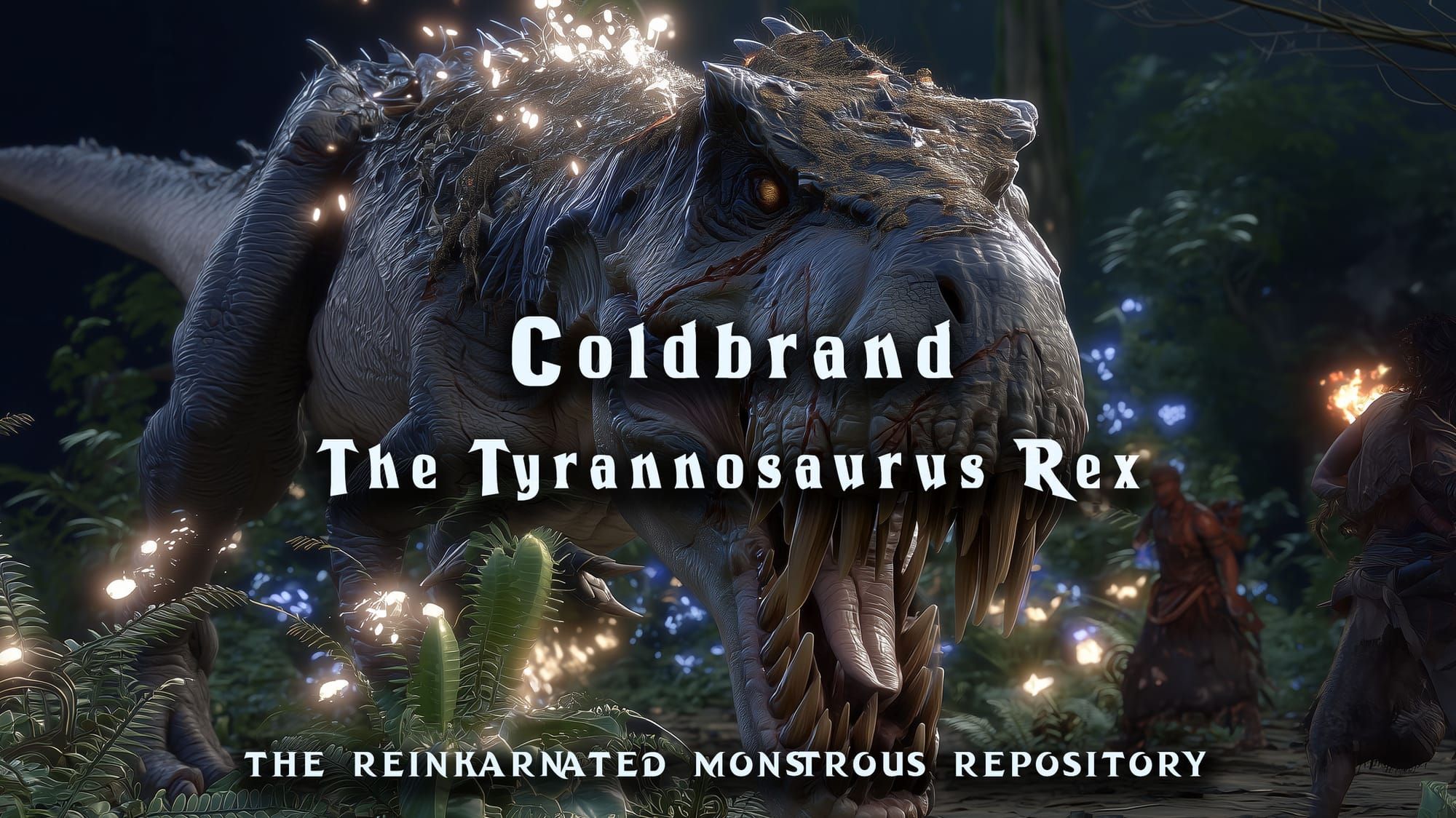
The silhouette is the oldest predator shape there is: a deep, heavy head carried level at the end of a thick neck, a body balanced over two enormous columnar legs, a tail held out straight behind for counterweight. Nose to tail-tip it runs about forty feet. Standing, its jaw is high enough to take a rider off a centaur's back without the animal changing its stride.
What you notice, though, is the surface. A coldbrand's hide is a dull pebbled slate under everything else, and everything else is grit — grey volcanic ash and powdered dead-flow stone pressed into every scale-seam and every fold, matted along the flanks, packed thick across the shoulders and the top of the skull where the animal grinds itself into a wallow. It is not decoration and it is not dirt it has failed to shed. It is maintenance. A coldbrand grooms it back on the way a bird preens, and a coldbrand that has been rained on for two days straight is a nervous, unhappy, conspicuous animal that will not hunt until it has fixed itself.
Against the Shroud's understory the effect is genuinely difficult to describe and immediately obvious in person. The forest floor glows. The vines overhead glow. The animal does not. It is not a black shape — black would catch and throw back the light. It is a dead grey absence, and what your eye actually reports is not a creature at all but a piece of the forest that has stopped working.
The head is scarred over the muzzle and the brow ridge, old healed grooves from forcing through firewillow scrub and from decades of arguments with things that fought back. Teeth are the length of a forearm, banana-thick, brown-stained, and slightly loose in the gum the way a shark's are — a coldbrand sheds and regrows them constantly, and a good tracker can date a wallow by counting what got left in it. The eyes are small for the skull, set forward, and a flat orange that catches a torch beam and holds it, which is the last useful information many people receive. The forelimbs are almost comically short, and they are not vestigial; they are hooks, and they are strong enough to pin a struggling elk-sized animal against the chest while the jaw does the rest.
It smells like wet ash and old meat. In the still air under the canopy you get that a half-second before anything else. Half a second is not nothing.
Backstory
A coldbrand is not born knowing the trick. That is the part the herders find unsettling once someone explains it to them.
A juvenile is a bright animal. It comes out of the nest thicket lit up like everything else in the Shroud, glowing at the elbows and the jaw from a night of blundering through fungus beds, and for its first years it hunts exactly as badly as that suggests — grabbing at frogs in the shallows, running down firefinches that were never going to be caught, going hungry a great deal. The wallowing starts as comfort. Cold ash on a hot day, in a valley where the ground itself radiates heat, is simply pleasant, and every large animal in Emberfall does some version of it.
What follows is not cleverness. It is arithmetic, applied over years by an animal with a brain the size of a fist: nights that begin in the wallow end in a full stomach far more often than nights that do not. So the wallow becomes a habit, then a routine, then the organizing fact of the creature's whole life. A grown coldbrand will pass up a hunt to dress itself first. It has favoured wallows and it defends them, and the deep hollows in the cooled flows where the grit is finest are worth more to it than any particular patch of hunting ground.
They are not numerous, and they are not social. The Shroud is fertile enough to carry a handful of them at once, spaced out along the flow-country between the hill-chains, each holding a range it walks in a long slow loop and marks with kills. Two adults meeting outside of mating is a short, loud, expensive event that both animals would rather avoid, and the scars on an old one's flanks are mostly from its own kind.
The one Cinderglade's herders are currently arguing about is old, big, and in the wrong place. Its range used to sit well inside the deep Shroud, in the green country under the great red canopy of the Emberheart, and it has abandoned that ground entirely. Something in there has stopped agreeing with it. Nobody can say what — the herders do not go that deep, the animal cannot be asked, and the only evidence is negative: a hunting loop that used to run north now stops short, turns, and comes down instead along the fringe where the livestock are.
It has not gone mad and it has not developed a taste for people. It has been pushed, it is hungry, and it has arrived in a place where the food does not know the rules. Ash-touched cattle have no idea that the dark patch in the glow is the thing to run from. Neither, for the most part, do travellers.