Glass Viper - The Giant Poisonous Snake
The ash out here swallows every sound. So when you hear one thin chime of glass, you have already stepped too close.
Role in Its Society
The Ashen Plains have no society to speak of. What they have instead is a short, hard-won list of things every scout, harvester and caravan hand out of Ash'rift learns before they learn anything else, and the glass viper sits near the top of it — above ash storms, below the big grazers, and a long way above anything the trade road can actually do about it.
It is not a rare animal, or a mysterious one. It is a fixture. The flats north of Ash'rift, where wind off the Serrentide Sea lays down volcanic ash the way a colder country lays down snow, hold more glass vipers than anyone has ever tried to count, and everybody who works out there knows exactly what one is. What the plains have never had is anyone willing to sit still long enough to write the animal down properly. Everyone in Emberfall can tell you what a glass viper is. Almost nobody can tell you how one actually works.
The first thing worth correcting is the assumption that it must be worth something. The plains do hand a few things over for free — there is glass out on the flats that a crew can gather off the ground by the sackful, and Ash'rift has built a great deal on top of that fact. The glass viper is not part of that arrangement and never has been. Its glass is not a crust the ashfields welded onto it. It is grown, from the inside, as part of the animal, laminated so thin and so tightly to living tissue that it comes apart the moment you try to take it off something that is still moving. When a viper sheds, what it leaves behind is not plate. It is a fine, frosted, crumbling grit that the wind has scattered by morning and that no carver on earth could do anything with.
What a glass viper is worth, it is worth twice, in very small amounts, and only ever dead. The fangs are the sharpest edge anybody in Emberfall has ever handled — hollow, needle-fine, and capable of an incision no steel blade can match, which matters enormously to the handful of Ash'rift's obsidian carvers and slagglass-wrights who do genuine precision work. So are the throat-plates: two dozen scales along the underside, thin enough to see daylight through, each one exactly the right size for a single inlay and worthless for anything larger. There is no trade in either. There is no season, no crew, no gathering. There is a carver who has been waiting two years for a good fang, and somebody who was willing to go out onto the flats and kill a snake for it.
Its neighbors, for their part, have all reached the same conclusion and reached it a long time ago. The ash-camouflaged cats that hunt the same flats — animals that will commit to almost anything that moves — do not go near a glass viper's ground and have not for generations. The flame wasps ignore it. The firewings, migrating low, simply do not land where the ground chimes. The vipers themselves work the margins, where the deep ash gives way to bare rock, which is precisely where anything crossing the plain on foot will naturally choose to walk.
One more correction, since this one gets people hurt: a glass viper is not a fire snake. Fire snakes are highland animals, marked with those faint glowing lines, found up in the rocky ground near the Cinderfen Range and the volcano's skirts. The glass viper is a plains animal. It does not glow, it does not run warm, and it does not want to be found. If you can see a serpent in Emberfall from more than a few paces off, it is not the one that will hurt you.
Appearance Description
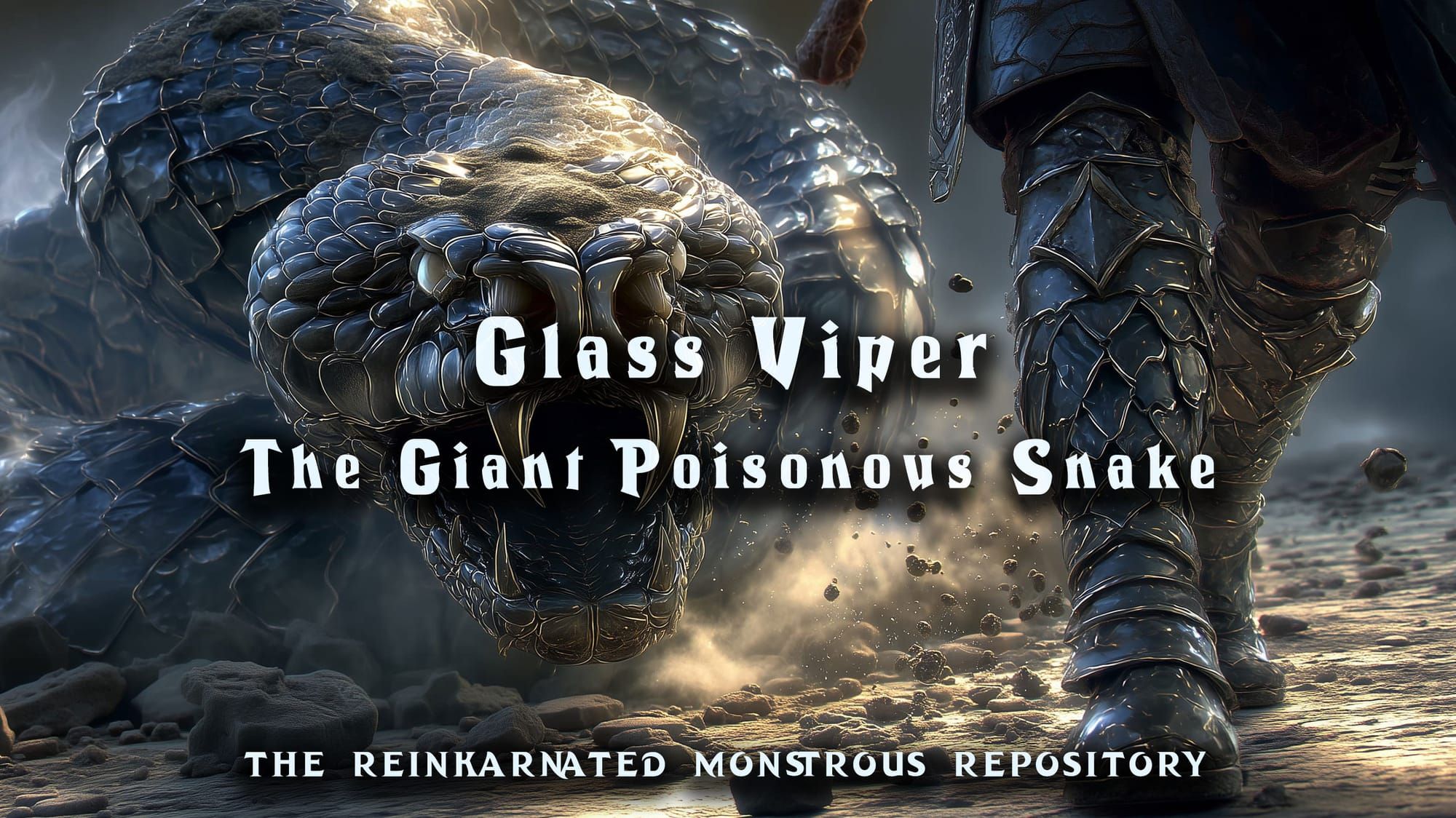
A full-grown glass viper runs eight to ten feet nose to tail and is heavy through the middle in a way that looks wrong for a snake, because a good third of that weight is not flesh. Its scales are mineral, and they are the animal, not a coating on it. Silica taken up over a lifetime is laid down through the skin from beneath as overlapping plates of true volcanic glass, black and slick as poured slag, grown seamlessly out of the living tissue underneath and hinged at every seam so the whole body still moves like a snake. Each plate carries a hairline rim of clear, colorless rind at its growing edge. Prise one off a dead viper and you get glass. Prise one off a living viper and you get a fistful of splinters and a very bad afternoon.
In direct light this is genuinely beautiful — a rippling black mirror, a river of obsidian pouring over the ground. In the flat grey overcast of an Ashen Season, which is the only light most people will ever see one in, it is a slightly wet-looking patch of broken basalt, indistinguishable from every other slightly wet-looking patch of broken basalt for forty miles. Ash settles on its back and stays there.
The head is broad, blunt and heavy-jawed, with two deep pits set forward of the eyes — the heat organs it actually hunts with. The eyes themselves are small, pale and nearly vestigial. Behind the jaw, the plates along the throat and flanks are shed-edged and slightly loose, and when the animal flexes them against one another they produce the sound the whole region knows it by: a thin, dry, carrying chime, like a wet finger drawn once around a wineglass rim.
The fangs are the strangest part. They are glass too — hollow, needle-fine, curved, and so brittle that a hard strike snaps them off at the root. That is not a flaw in the animal. It is the animal's entire strategy.

Backstory
The glass viper has been on the Ashen Plains for as long as there have been Ashen Plains, which is to say longer than anyone in Emberfall has been counting. It is not a corrupted thing, a cursed thing, or a thing that came from anywhere. It is what happens when an ordinary ambush serpent spends enough generations in a landscape where the sky is made of powdered stone.
The mechanism is simple enough that a patient naturalist could work it out in a single season, and nobody ever has. The plains bury everything: shallow soot dunes, wind-scoured basalt, and under all of it the half-swallowed shapes of old fire temples and older battlefields, going down and down. A serpent hunting that ground eats what it can catch, and everything it catches has spent its own life eating ash. Silica goes in, and over years it comes back out through the skin as structural plate — not fused on from the air the way the plains armour their heavier animals, but grown, from underneath, the way any other creature grows a claw. The glass viper does it faster and more completely than anything else on the flats, and it has built an entire way of living on top of that one adaptation.
It cannot outrun anything. It has no interest in trying. What it has is a body the exact colour and texture of the ground, a sense that reads warmth straight through the ashfall that blinds everything else, and a mouth full of disposable glass needles. It does not stalk. It does not chase. It lies flat where the deep ash thins out toward rock and lets the sky bury it, and then it waits — sometimes for days — for something warm to put its weight down within ten feet.
And before it strikes, almost without exception, it chimes. That single note is the most misunderstood thing about the animal. It reads as a threat, and people who hear it tend to freeze and then, catastrophically, look down and lean in. It is not a threat. A glass viper's fangs cost it something real to spend — a hard bite shatters them, and it will be an hour regrowing a set. The chime is the cheapest possible way of saying go around, and the overwhelming majority of creatures on the Ashen Plains, from firewings to the plains cats to experienced Ash'rift hands, do exactly that.
The ones who don't are why the plains keep a list.