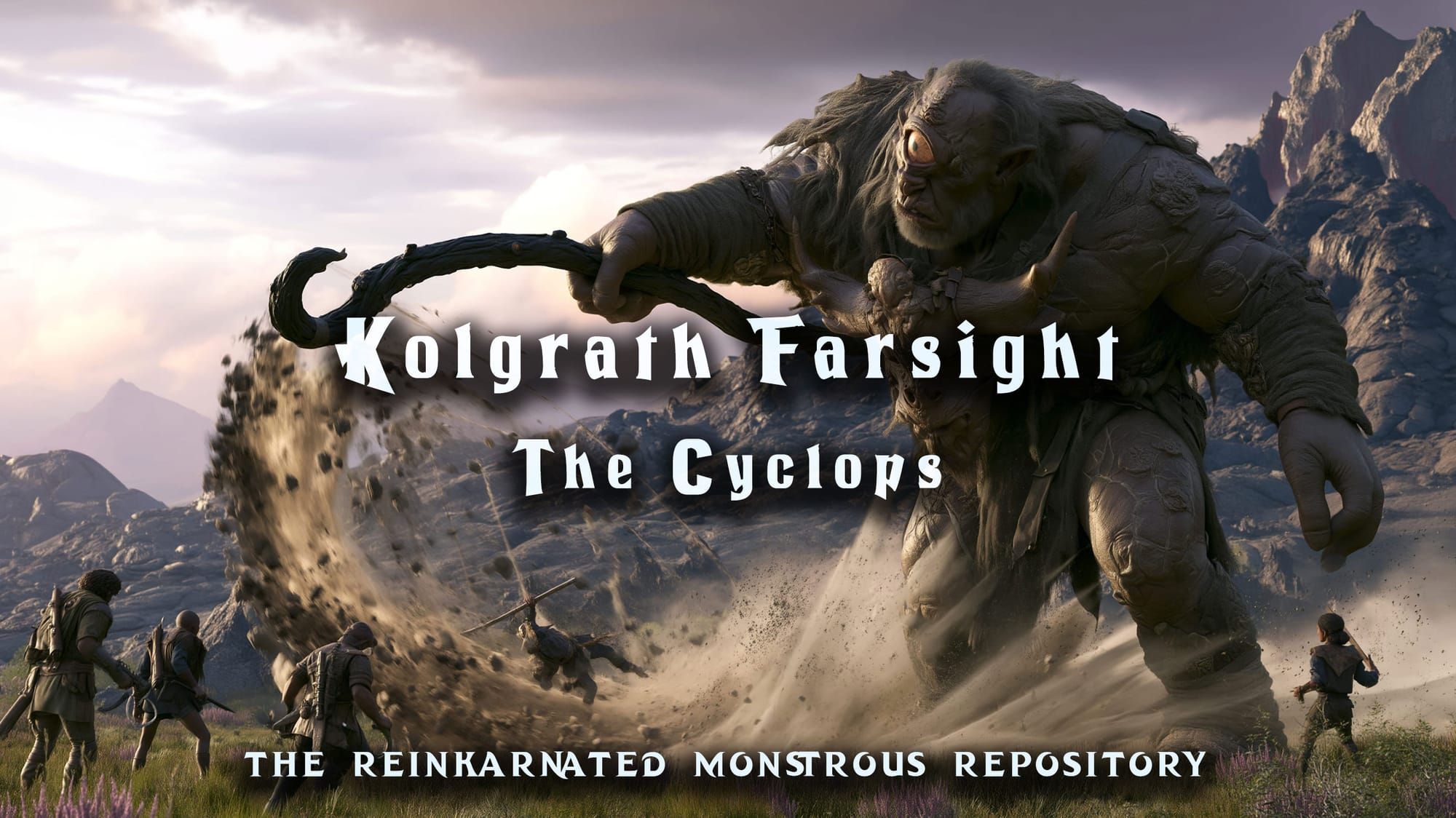
Kolgrath Farsight - The Cyclops
Cinderglade's herds aren't the only ones grazing these plains — his just happen to stand thirty feet tall.

Role in Its Society
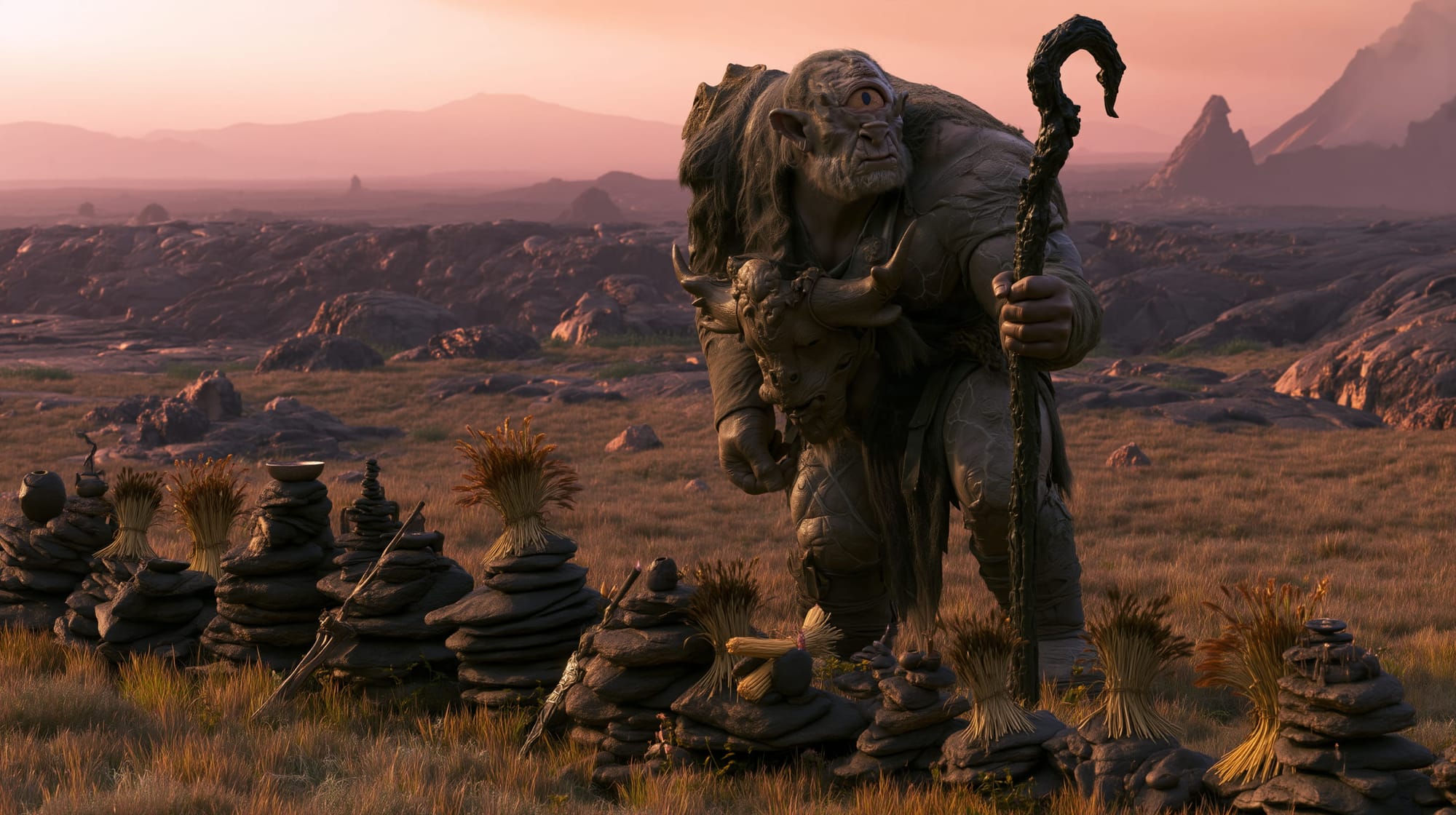
Cinderglade's herders don't have a proper name for him in their own tongue. They just point southwest, past the line of stacked black stones, and say "Farsight's ground," and everyone who's grown up on these plains knows exactly what that means and exactly how far to walk before they'd better have something to leave behind them.
Kolgrath isn't part of Cinderglade's society in any sense the plainsrunners would recognize — no clan claims him, no rite includes him, no fire in the enclave has ever been his to sit at. But he fills a role their culture already understands completely, because he's doing the same work they are: keeping a herd fed on the same fertile, ash-fed plains a few miles southwest of Mount Vendetta, where the grazing runs richest. His animals are cinderhorns, colossal single-horned grazers half again the size of Cinderglade's largest ashmane bull, and a herd that size needs country to match — the deep grass shelves along the old cooled flow that no centaur herd has ever safely reached, walled in by loose scree and a drop no hoofed creature will take twice.
That ground is his by simple virtue of being the only one who can stand on it. The trouble starts in the Ashen Season, when the high shelves thin out and his cinderhorns push down toward the same lower plains the plainsrunners depend on to survive the dust. Neither people has ever needed a treaty to manage that, because neither people wants a fight over grass when there's a much simpler answer: a line of stacked, sun-blackened stones that has stood — restacked, added to, occasionally toppled by weather and rebuilt — for longer than anyone currently walking Cinderglade's plains can say who first raised it. Cross it without leaving something behind, even something small, and Kolgrath reads it as trespass. Leave the toll, and he reads it as neighbors passing through.
Appearance Description
He isn't, up close, the kind of giant that announces itself with menace. Kolgrath stands roughly thirty feet at full height, though he rarely straightens all the way — most of his waking hours go to standing half-bent, checking a cinderhorn's footing or scanning the grass line, and the habit has permanently rounded his shoulders. His skin is the deep grey-brown of old cooled lava rock, seamed through with paler cracks where the hide has weathered and reformed over decades in the open ash-fall, and a fine crust of pale grey dust clings to every fold of him no matter the season. Plainsrunners who've stood near him say he's worn more ash than most people breathe in a lifetime, and it shows.
His single eye sits wide and deep-set beneath a heavy, jutting brow, its iris the exact burnt amber of a cinderhorn's own, and it almost never stops moving — he reads the horizon the way Kestrin Longmane reads a nervous ashmane's ears, constantly and without seeming to try. He wears a mantle cut from a cinderhorn hide he lost to old age rather than the knife, its pale scarring visible along one flank, and carries a crook of fire-blackened basalt taller than most trees, worn glass-smooth at the grip from decades of leaning on it, guiding a wayward calf with it, and occasionally planting it hard enough to crack stone.
Backstory
Nobody in Cinderglade can say how long Kolgrath has kept his herd on the deep shelves southwest of Mount Vendetta — only that he was already there, with cinderhorns already grown old under his care, when the oldest living plainsrunner grandparents were themselves calves at their mothers' flanks. He doesn't correct the assumption that he's always been there. He isn't especially interested in being understood. What matters to him is simpler and, as far as he's concerned, considerably more obvious than any settlement's memory of him: a herd needs ground, ground needs tending, and tending is not something he has ever seen a reason to stop doing.
The line of stacked stones marking his boundary is his own work, added to across what must be a very long lifetime, and he treats every stone in it as a kind of promise kept — both the promise that he'll hold this ground for his herd, and the quieter one that he won't push past it looking for more than he needs. He has met Kestrin Longmane at that line more than once. Her herd's summer range runs nearer his ground than most of Cinderglade's, and she is, in his private and rarely-voiced estimation, one of the only plainsrunners who reads a boundary marker correctly on the first look rather than the third. Their exchanges are short, wordless more often than not, and entirely without warmth by any ordinary measure. They amount to a nod, sometimes a long shared silence over a particularly good stretch of grass, and an unspoken agreement that neither of them will pretend the other doesn't exist. It isn't friendship. It's two herders recognizing the same discipline in each other — and on these plains, that turns out to be worth quite a lot.