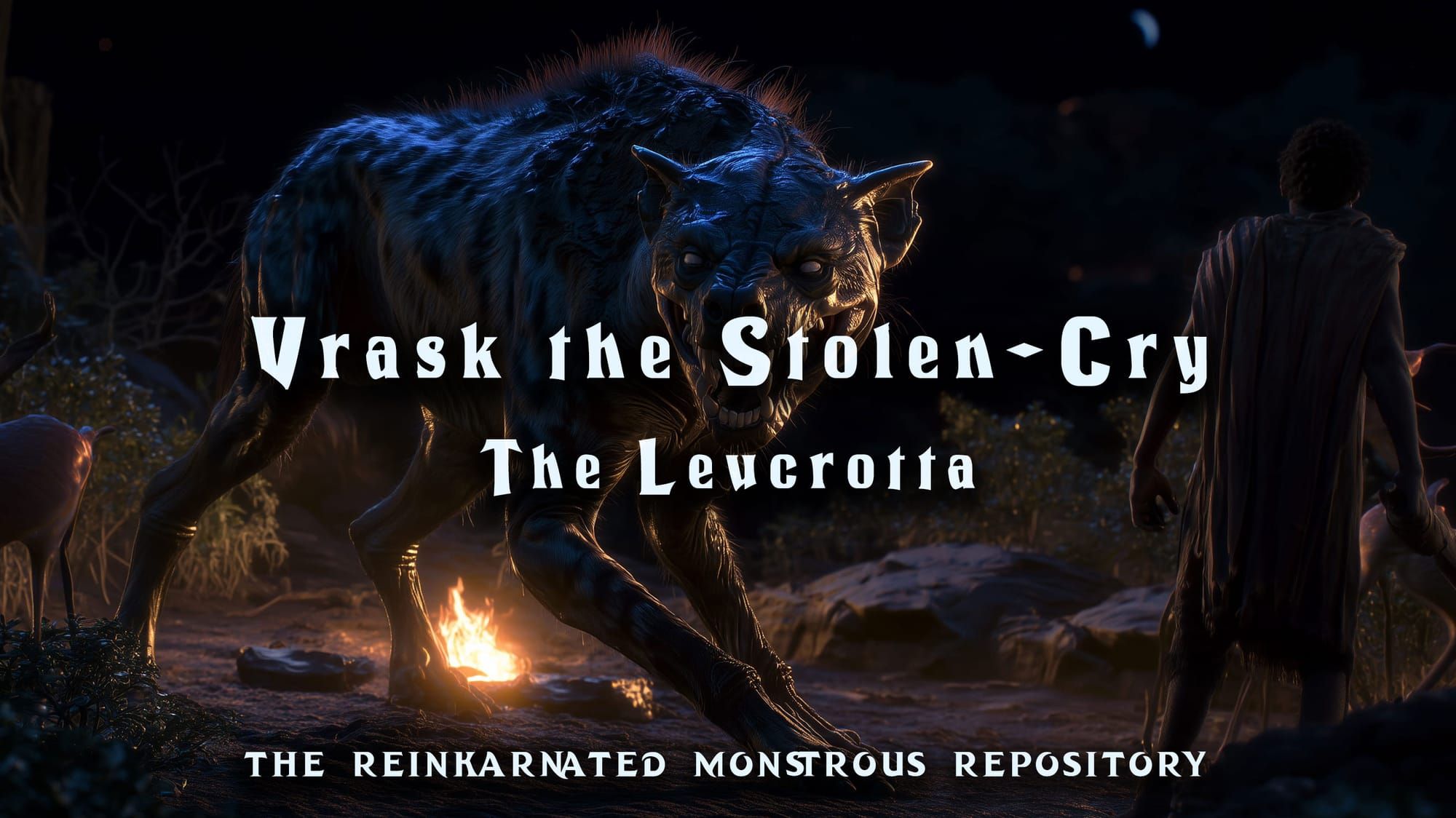
Vrask the Stolen-Cry - The Leucrotta
You know that cry — you raised that calf. Vrask has been listening long enough to know it too.

Role in Its Society
The plains south and east of Cinderglade thin out fast once you pass the last grazing line — open ash flats, cooling basalt, the heat off the main lava flow a few miles further on. Nothing much survives out there on brute strength alone; the ground is too bare to hide a charge and too loud underfoot to sneak one. What survives out there survives on patience, and nothing on those flats is more patient than Vrask.
Cinderglade's herders already know the plains keep their own kind of quiet. The worg packs that range the upper Ashen Plains further north learned years ago to stop howling and start talking, close and low, because the ash eats sound at any real distance — a fact every plainsrunner who's traded words with one of those packs across a firelight can tell you. Vrask has made the opposite discovery. It doesn't need to be heard at a distance either. It needs to be believed at one, and for that, its own voice is worthless. So it doesn't use it. It waits at the edge of a grazing line, patient as the ash itself, until it has heard enough — a mother calling a straying calf, a herder's own name shouted twice across a dusk count — and then it gives that sound back, note for note, from wherever it will do the most good.
It isn't feared the way a pack or an apex predator is feared. Most of Cinderglade has never seen it and couldn't describe it if pressed. What they know instead is a rule, taught early and taught hard: never answer a call alone, no matter how sure you are of the voice, until the whole herd has been counted first. It's a rule with no story attached for most who repeat it. For the herders who tend the flame elk lines nearest the flats, it has a story attached, and they don't tell it often.
Appearance Description
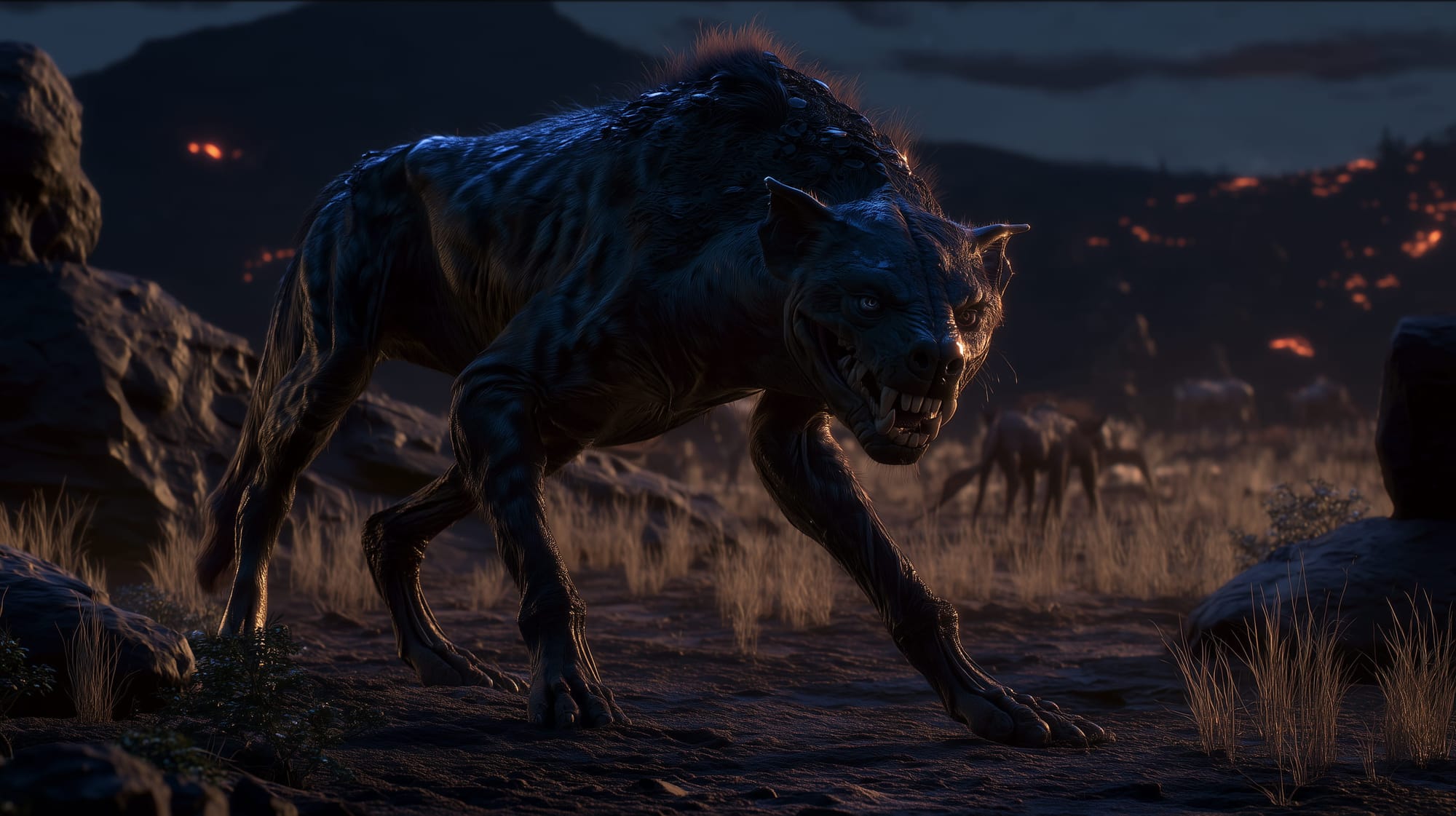
Vrask stands as tall as a plains pony at the shoulder, built along two mismatched frames stitched into one animal. The body is thick, low, and hyena-heavy — a wide chest, a sloped spine, powerful shoulders under a coat of coarse grey-black stripe-work gone dull with packed ash. Beneath that heavy body run four long, slender legs ending in cloven, deer-like hooves, built for a fast, near-silent trot across loose cinder and drift rather than for a hyena's rolling lope. The mismatch reads wrong at a glance, and that wrongness is the first thing anyone notices before the second thing gets them killed.
Its head is broad and flat-browed, set with small, deep-socketed eyes the color of wet slate that give away nothing. Its mouth is the detail no one describes the same way twice: a wide, lipless seam that splits nearly ear to ear when it opens, lined not with a beast's teeth but with a single hard, ridged bone plate along each jaw, worn glass-smooth at the edges from years of grinding against itself. Deep in its throat, half-hidden behind that unsettling grin, a loose fold of resonant tissue works like a second, borrowed set of vocal cords — the part of it that does the actual lying.
Its hooves fall almost soundlessly even on broken basalt, and its coat holds ash the way old felt holds dust, breaking up its outline against the grey flats until it is close enough that outline no longer matters.
Backstory
Nothing about Vrask needed to be taught. It hunts the way it hunts the same way a spider spins — not from cleverness, but from an old, blunt instinct doing exactly what it was built to do, generation after generation, on ash flats that have never rewarded anything else. It has always ranged this stretch of Cinderglade's grazing country, keeping to the thin, dry belt between the last good grass and the real heat of the flow, moving with the herds rather than against them, because a herd is where the voices worth stealing come from.
It doesn't remember individual hunts the way a thinking creature remembers a history. What it carries instead is accumulated sound — years of listening at the edge of firelight and grazing lines, building up a private hoard of calls, names, and cries it has never once needed to understand to use perfectly. A calf's bawl. A herder's own name, shouted twice across a dusk headcount. The particular rising note in a voice calling a lost animal home. None of it means anything to Vrask. All of it works.
There was a stretch, two seasons back, when three flame elk calves went missing from the herds nearest the flats inside the same handful of weeks, each one following what sounded exactly like its mother's call into ground where no mother had ever been. It's the kind of pattern a careful herder notices before anyone else does — the kind Kestrin Longmane noticed, and has spent every season since teaching apprentices to notice too, without ever needing to say out loud what she thinks made it happen. She hasn't seen Vrask. She has simply stopped letting anyone walk out alone toward a voice in the dark, hers included, until the herd is accounted for first.