Wickthieves - The Swarm of Ravens

Wickthieves - The Swarm of Ravens

The Shroud lights itself at night. Bring a torch anyway, and something with a thousand wings will come put it out.

Rich

Role in Its Society

The Verdant Shroud does not need anyone to bring it a light. That is the first thing the plainsrunners tell anyone heading in after dusk, and it is the only piece of advice that actually matters. Where the Shroud and the Cinderglade range sit against one another in central-western Emberfall, the long-cooled lava flows have gone under a canopy so thick and so wet that daylight barely reaches the floor — and it does not have to. Once full dark settles, the underbrush comes up green and gold on its own. Glowing fungus beds run along the roots. The ash-bloom vines hold a faint cold shine in their throats. A person who stands still for ten minutes and lets their eyes adjust can walk the whole Shroud by the light the Shroud makes.

The fire-ravens are what live in that light, and what keeps it honest.

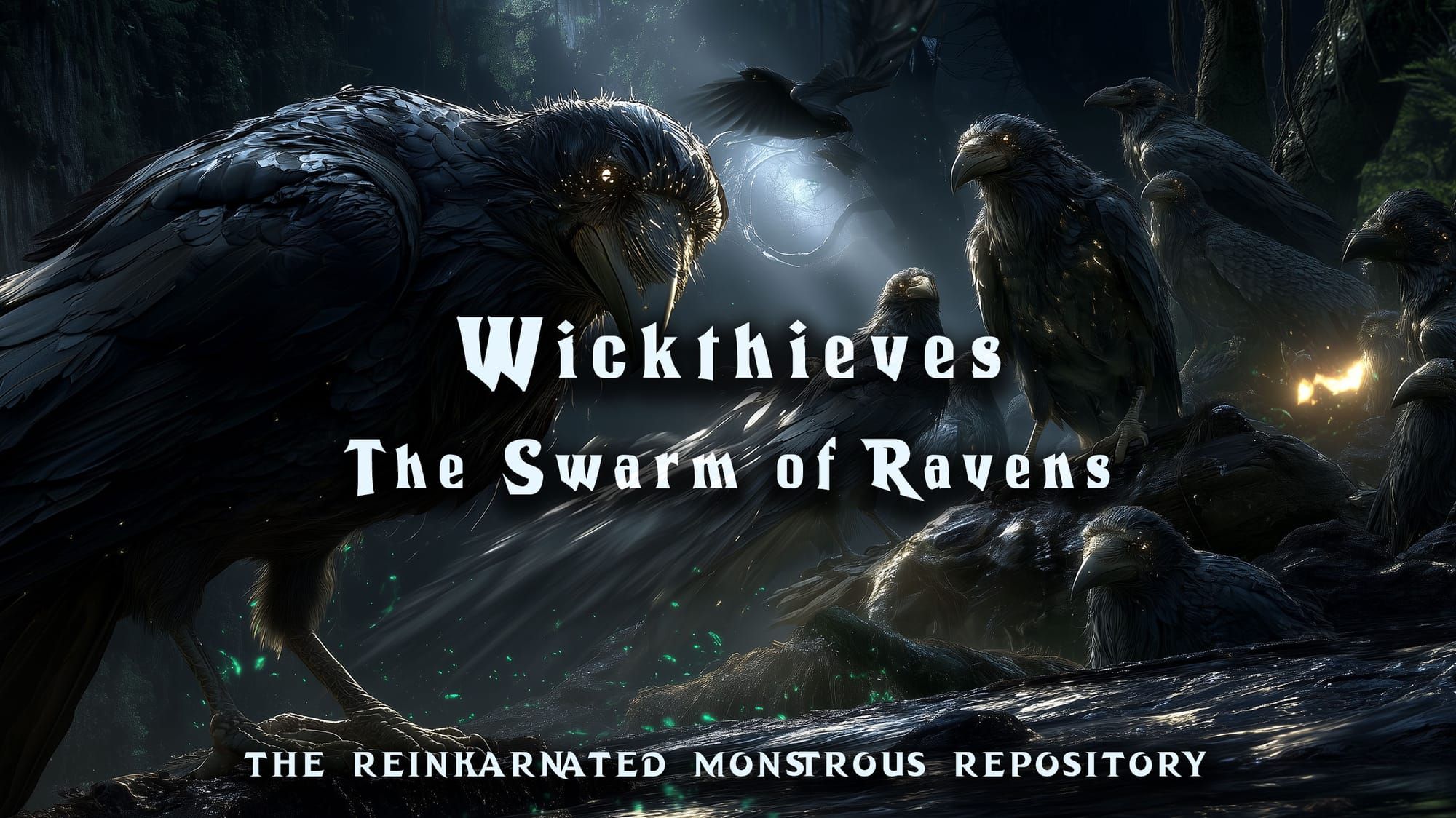
Individually they are nothing — hand-sized, ember-winged, quick, feeding on emberpetal nectar and stripping ash-bloom seed and working over the firewillow blossoms in tight nervous bursts. The plains crews out past the Cinderfen call them firewings and watch their migrating ribbons cross the grey flats twice a year; the Shroud calls them fire-ravens and sees them all year round. Nobody who has watched both has ever been able to tell them apart. What the Shroud has that the plains do not is the roosting — tens of thousands of them coming down into the same few firewillow stands at dusk, until the trees themselves look lit from inside.

And a roosting flock has exactly one thing it will not tolerate.

An unshielded flame in the Shroud after dark is not a small thing. It is brighter than every light the valley makes put together, it moves, it throws shadows the birds cannot read, and it sits in the middle of a place their whole night depends on being predictable. A flock does not investigate it. A flock does not circle it. A flock comes down on it all at once, in a single rising sheet off the branches, and puts it out — beating it flat, tearing the burning wick loose, carrying coals up into the wet canopy where they gutter and die. The ravens take casualties doing it. They do it anyway. They have always done it, and every living thing in the Shroud with any sense at all has arranged its habits around the fact.

Which is why Cinderglade reads them. A people whose shamans take the tremors of the earth as sacred omens, and who find the future in rising flame and shifting ash, were never going to ignore a hundred thousand birds that all decide the same thing at the same moment. Outriders have watched the dusk flights out of habit for as long as anyone has kept herds down here — not for prophecy, particularly. A flock that turns is the cheapest early warning in Emberfall, and it costs nothing to look up.

Appearance Description

A single fire-raven is a small, tidy, unremarkable bird: dark-bodied and round, with a stubby seed-cracking beak and a glossy black eye. What is remarkable is underneath. The primaries and the deep down along the breast are a live ember orange, banked and dull when the bird is settled and folded, brightening as it works — so a finch at rest reads as a dark smudge on a branch, and a finch in flight reads as a spark thrown off a fire.

The flock is a different animal entirely. Ten thousand of them coming off a firewillow at once do not look like birds. They look like the tree has caught along one whole flank, and the fire is coming off it sideways and staying together — a low burning sheet that banks, folds, doubles back on itself, and holds a shape no fire ever holds. The sound arrives with it and is worse than the sight: not calls, not shrieking, just the dry continuous rush of that many wings, rising as they close, and then all around you.

Inside the swarm, individual birds are almost impossible to see. There is heat, and the smell of hot down and crushed emberpetal, and a constant fine battering, and the beaks — small, blunt, hopeless things, and there are more of them than there are square inches of you.

Backstory

Nothing made the fire-ravens this way. That is worth saying plainly, because the reflex in Emberfall is to assume the volcano is behind every strange animal in it, and this once it simply is not. The Shroud grew back over dead lava with a bioluminescent floor and a canopy that shuts out the sky, and a small bird that navigates and feeds and finds its roost by that soft, even, unchanging glow will eventually and inevitably become a bird that treats a bright moving flame as an emergency. The mobbing is not malice, and it is not intelligence. It is a very old, very simple animal answer to a problem, arrived at by a species that could not afford to be wrong about the dark.

The Shroud rewarded it. A flock that snuffs stray fire in a valley of fire-adapted greenery is a flock that keeps its own roost stands standing, and firewillows that keep standing hold more ravens the following season, and so on, for longer than anyone has been counting. It is one of the few arrangements in Emberfall where the fire loses and the green wins, and it is a large part of why the Shroud looks the way it does.

What the herders have been passing along lately does not fit that.

The flocks have moved. Not all of them, and not far — but roosts that held the same firewillow stands deep in the Shroud for every season anyone can remember have come apart, and the birds have turned up on the wrong side of the hill-chains, settling into thin scrub that will not feed them, at hours they have never flown. They are mobbing things they never used to bother with. An outrider's banked cookfire, well outside the treeline, on ground the flocks had no business being on at all. A steam vent. A lantern on a picket line two ridges out.

Nobody can say what moved them. The sages who have gone in to look came back with observations and no answers, and the observations are mostly about the deep Shroud rather than about the birds — the Emberheart weeping burning sap down its own trunk, the stands nearest it grown strange and grabbing, the ground warmer than it ought to be in places it never was. Whether the ravens are fleeing that, or something else entirely, none of them will guess out loud. What everyone agrees on is narrower and harder to argue with: the most reliable animal in the valley has stopped being reliable, and it started with the ones nearest the tree.

🛡 A fine map and a stout companion await. Access all character scrolls and battlefields for just $5 a month. Join the Local Heroes!

Check out the available ranks
📝 Join the Guild!
🔐 Already have an account? Return to the Guildhall Log in