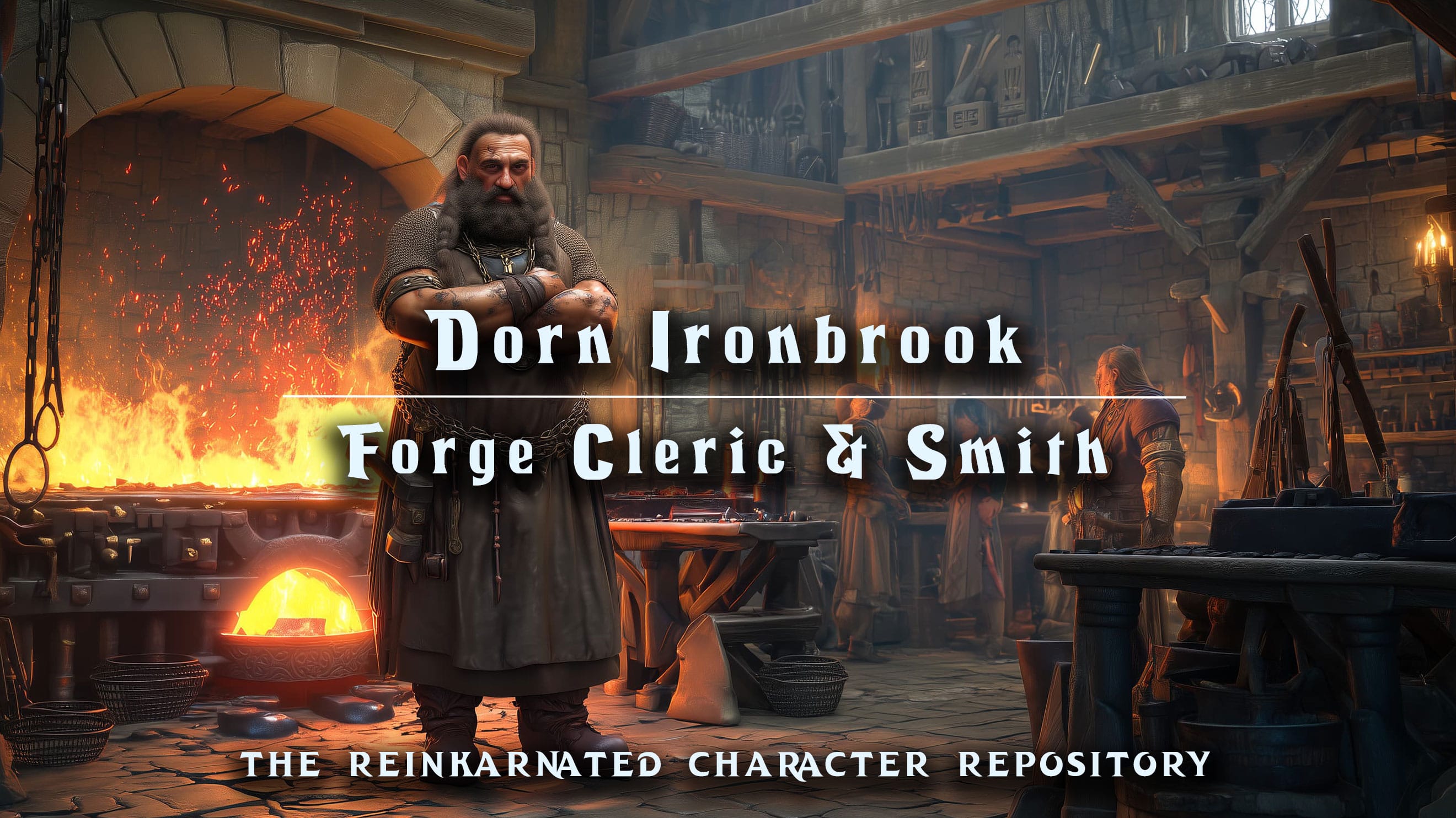

Name: Dorn Ironbrook
Race: Mountain Dwarf
Role/Class: Smith / Forge Cleric Level 9
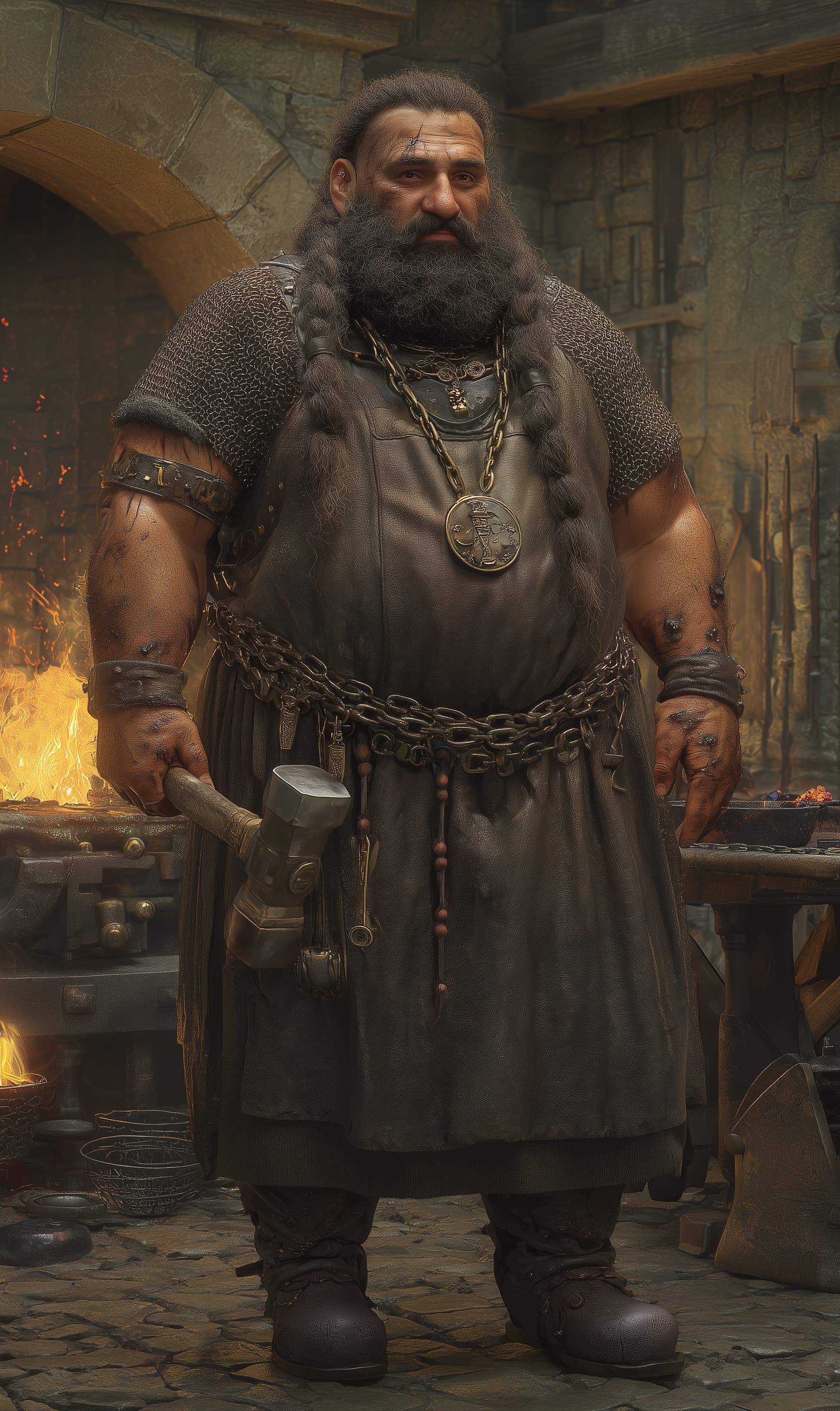
Appearance: Dorn Ironbrook is built like an anvil in motion—broad, compact, and solid in a way that makes doorframes nervous. His skin is a deep ruddy brown, permanently smudged with soot no matter how often he scrubs. Thick black hair, threaded with gray, is pulled back into a short, practical tail; his beard is boxy and well-braided, bound in copper rings stamped with simple smith marks instead of ornate crests. His dark eyes are sharp and assessing, flicking from edge to edge, from joint to haft, from stance to stance with an appraiser’s instinct.
He wears a heavy leather apron over a set of chain mail whose rings have been subtly reinforced and etched with faint sigils. The apron is scorched and patched, but meticulously maintained. A thick-shouldered hammer hangs from one hip, its head a mix of work-scarred steel and runic inlay; from the other hip jangle keys, calipers, and a few small tongs. His forearms are rope-muscled and scarred from burns, and the faint smell of coal, hot iron, and oil clings to him like a second cloak. A simple holy symbol—a stylized anvil flanked by crossed tongs—hangs from a cord around his neck, burnished from constant handling.
Backstory
Dorn was born in a mountain hold of the Briarthorn Bluffs where the forge was both chapel and council chamber. As a boy, he thought the ringing of hammers was the sound of the gods thinking. His clan expected he would follow the usual path: apprentice in the family smithy, inherit the shop, marry, and spend a contented life shod in iron filings. But Dorn had two problems: a knack for asking uncomfortable questions, and a strong sense that metal, like people, should serve a purpose greater than pride and profit.
When he was still young, a dispute over a shipment of inferior weapons turned violent between his clan and a neighboring human barony. Steel was drawn; blood was spilled. Dorn watched blades he’d helped polish bite into bodies because no one would admit fault or yield a little profit. It shook him. When a wandering priest of the forge gods later preached that “craft is covenant”—a sacred pact between maker, user, and those affected by the tool—Dorn listened. He took orders as a cleric soon after, trading the certainty of clan walls for the unpredictable paths of pilgrims, craftsmen, and the people who needed them.
His travels eventually led him to the Ardent Woods and its bustling border settlement, a place crying out for a reliable smith who wasn’t tied to any one power. Here, woodcutters, caravans, wardens, and adventurers all needed arms and tools—but the forest’s guardians feared the wrong weapons in the wrong hands. Dorn stepped into the gap. He established the town’s only permanent forge, on the condition that he serve as neutral arbiter in disputes over metal: who gets armed, how much, and at what cost.
Over the years, Dorn has become part blacksmith, part priest, part judge. He keeps prices fair, refuses to sell certain types of weapons to people he doesn’t trust, and quietly marks every major piece that leaves his anvil so he can recognize it later. He’s seen what happens when greed and fear outpace wisdom, and he’s determined that, in this town at least, the line between tool and atrocity will be watched.