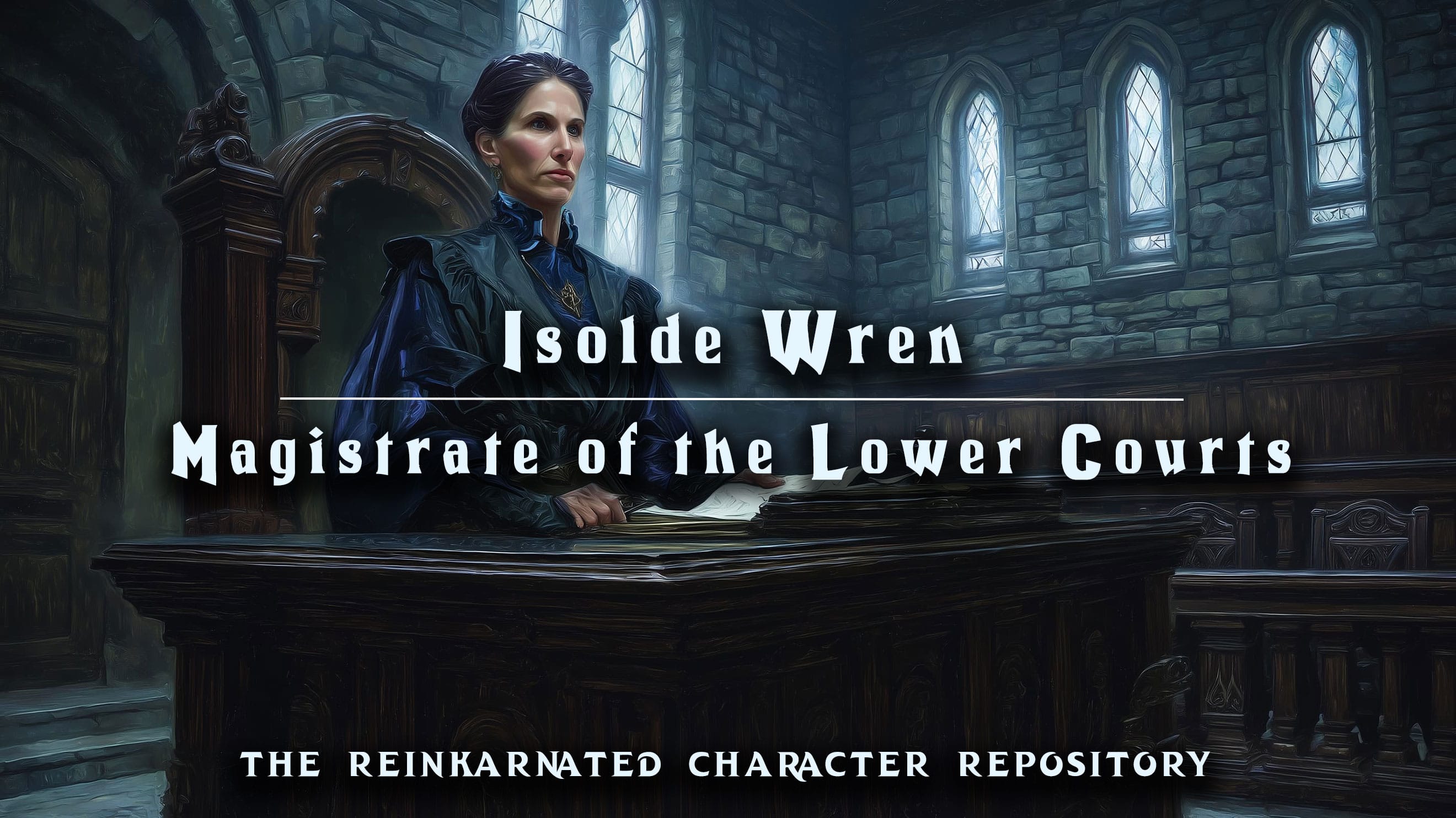
Isolde Wren – Magistrate of the Lower Courts
"The law as written and the law as applied are two different instruments. My job is to know which one the situation requires and to be able to defend the difference in writing."

Name: Isolde Wren
Race: Human
Role/Class: Magistrate of the Lower Courts
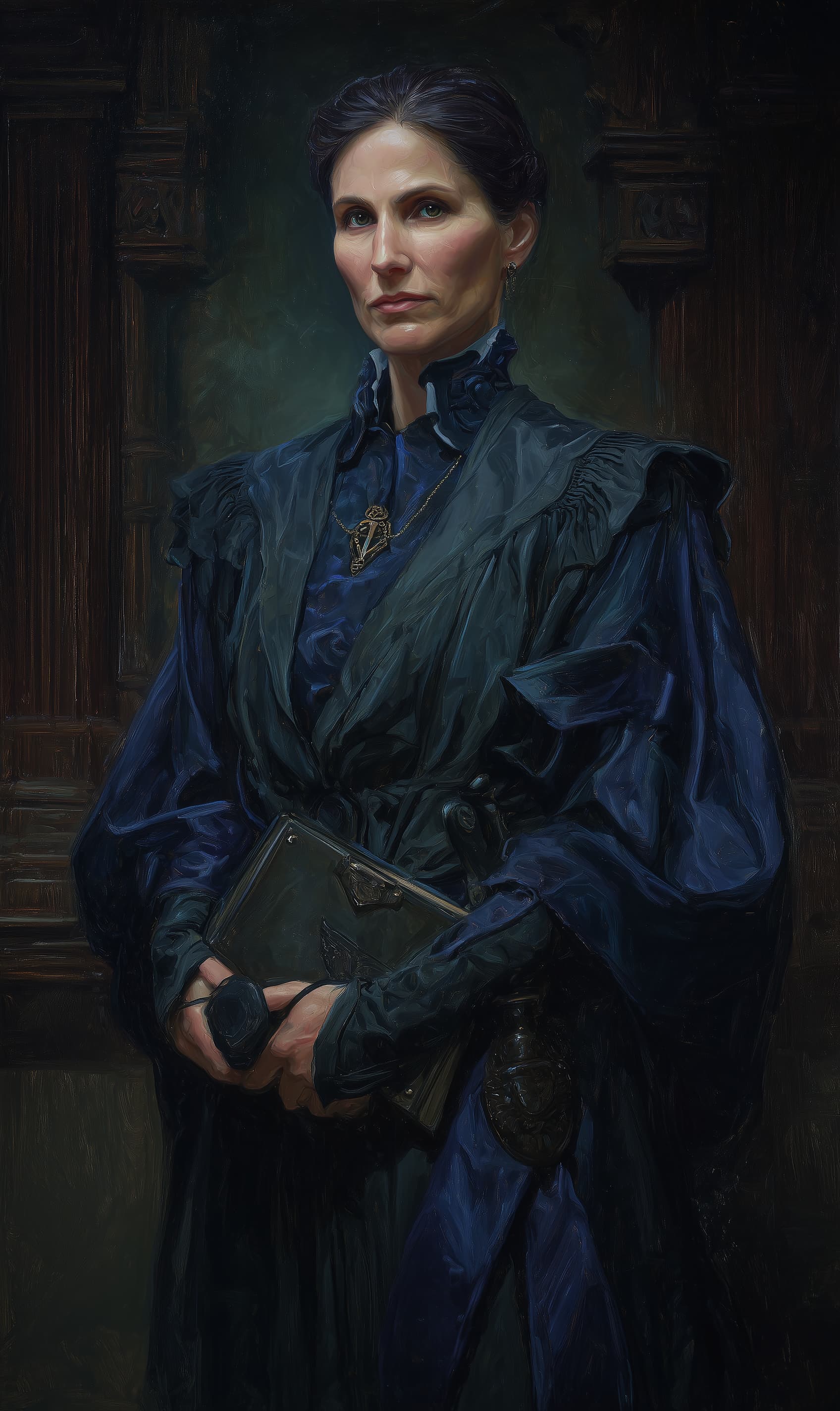
Appearance: Isolde Wren is forty-four, a lean woman with the kind of angular face that conveys authority more efficiently than any judicial robe — sharp cheekbones, a strong nose, and pale grey eyes set in dark skin that carry the particular quality of eyes that have heard thousands of people's worst decisions and have not stopped taking each one seriously. Her dark hair is worn back from her face in a severe practical knot beneath her magistrate's collar — a stiff dark blue band that she straightens by reflex whenever it shifts. She wears the formal black robes of the lower courts with a grey sash and the small bronze scales pin that marks her judicial rank, and she carries a slim leather case of current case files wherever she goes outside the courthouse, held at her left side with the practiced grip of something she stopped noticing she was carrying years ago.
Backstory
Isolde Wren did not plan to become a magistrate of the lower courts. She planned to become a magistrate of the upper courts, where the cases were larger, the stakes higher, and the legal questions more intellectually interesting. She passed the Crown's judicial examination in the top three of her cohort, took a lower court appointment expecting to move upward within five years, and discovered at year three that the lower courts were where most of the city actually lived, legally speaking — where the disputes that shaped daily life in Brightcrown were resolved or failed to be, where the gap between the law's intention and its application was widest and most consequential, and where the magistrates assigned were most often the ones least invested in closing that gap.
She stayed. She has been in the lower courts for eighteen years and has developed a working philosophy that is simultaneously deeply committed to legal principle and practically aware that legal principle applied without context produces outcomes that undermine the principle's purpose. She handles cases that the noble houses prefer not to escalate and cases that the guard doesn't have the evidence to prosecute formally and cases that nobody else will take, and she does it with a rigor that has made her the most referenced magistrate in the lower courts and the most frequently complained-about magistrate in the palace's judicial oversight committee.