Khuldryn Blackvein - The Duergar
“Gold is a noise. Stone is a promise. Chains are how you keep both.”

Role in Its Society:
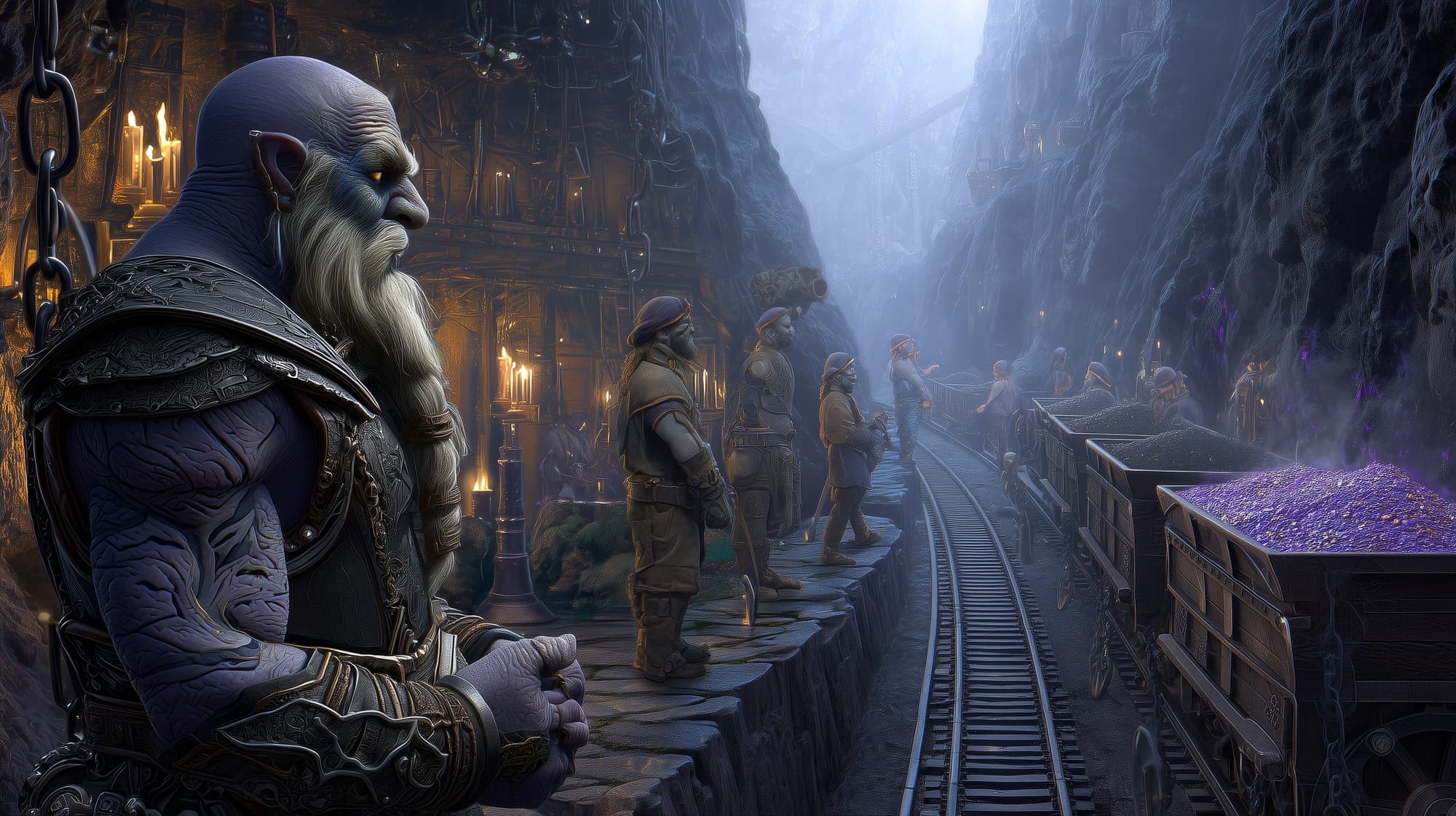
Khuldryn Blackvein is a slave-marshal and tunnel-thane in a sprawling duergar fortress-city, ruling a stretch of mines, forges, and labor tunnels known as the Ashen Galleries.
He’s not the king, nor a grand despot—but he’s the one most captives and neighbors actually fear. Khuldryn is responsible for:
- Organizing and disciplining forced labor lines of slaves and punished duergar.
- Maintaining key tunnels, bridges, and slag-pits that feed the city’s forges.
- Enforcing quotas and collecting “stone-tithes” from those who work or trade in his section.
To duergar, he is a necessary cruelty, praised for never missing a quota and for keeping his workers alive just long enough to be worth the food. To slaves and neighboring races, he’s a gray iron nightmare who knows exactly how much pain and pressure a body can take before it breaks—and sometimes pushes past that just to make a point.
Outside his fortress, Khuldryn operates mobile work-gangs, salvage squads, and chain-guard patrols, forcing the Underdark itself to yield ore, slaves, and routes. He’s a denizen of the deep, but in his domain, he’s unmistakably an overlord.
Appearance Description:
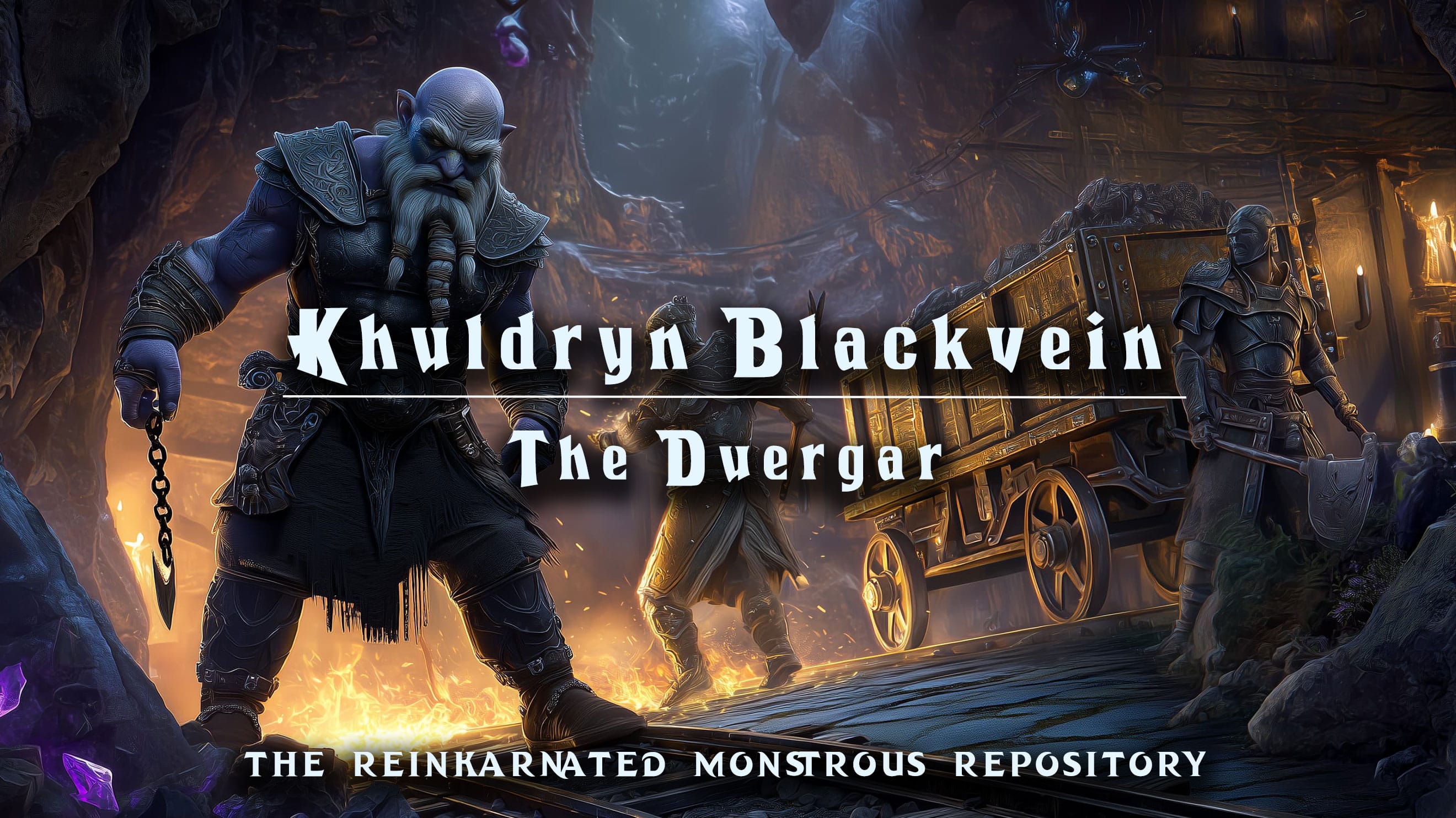
Khuldryn is a broad-shouldered duergar with the build of a lifetime miner and enforcer. His skin is ashen gray, the color of cooled forge-stone, crisscrossed with old burn scars and pale lines where shackles once bit deep.
His beard is thick but kept tightly braided, the strands bound with black iron clasps that resemble links of chain. Streaks of darker pigment or tattooed “veins” run from his throat down his arms—thin black lines like fissures in rock, hence the name Blackvein.
He wears heavy, functional armor: dark iron scale or half-plate stained with soot and slag, the surface matte from years of use. Over it, he dons a sleeveless leather overcoat bearing his insignia: a stylized chain encircling a hammerhead. His gauntlets are reinforced with knuckled plates shaped like small anvils, each strike a reminder of the forge.
At his belt hang:
- A brutal, short-hafted war pick with its spike worn shiny from rock and skull alike.
- A loop of hooked chains, some barbed, some ending in manacles, all well-maintained.
- A ring of keys and strange metal tokens stamped with tally marks and tunnel sigils.
When his innate enlargement power is active, Khuldryn’s already imposing frame swells to an ogre’s height, armor stretching but not breaking, chains rattling like the clatter of an approaching mine-cart. His eyes burn with a cold, ember-orange glow whenever the forges of his anger are stoked.
Backstory:
Khuldryn was not born into privilege—he earned it with iron, blood, and stone dust.
His early years were spent in punishment tunnels, a youth “corrected” for disobedience by being thrown onto the harshest shifts: deep drilling, slag scraping, and corpse hauling. There, he learned two truths:
- Stone never complains.
- Those who complain don’t dig long.
When a catastrophic tunnel collapse trapped his crew, Khuldryn took command. He rationed water, set a work schedule, and used brutal discipline to hold madness at bay. Three days later, when a rescue team finally broke through, his entire crew was alive—and the tunnel had been expanded and braced according to his shouted orders through the rock.
The overseers noticed.
He was pulled up from the punishment lines and retrained as an enforcer, then promoted again to tunnel-thane and slave-marshal of the Ashen Galleries. Over decades, he:
- Increased ore output without significantly raising death counts—though he counts crippling injuries as “acceptable losses.”
- Developed a system of iron tokens and marks that let him track productivity, punish slacking, and quietly reward those who overperformed.
- Built a reputation for always delivering on his promises to superiors—and always making examples of those who broke their word to him.
Khuldryn has little love for grand politics or gods. He believes in stone, work, and control. Still, he harbors a quiet grudge against the noble caste that threw him into the punishment tunnels as a youth. If an opportunity arose to rearrange the hierarchy—without jeopardizing his galleries—he might seize it with the same iron certainty he brings to his chains.