Vaessyra - The Medusa
“She does not turn you to stone for looking at her. She turns you to stone for refusing to look away.”

Role in Its Society:
Vaessyra exists at the edges of civilization, where law has failed but memory still clings to the land. Unlike medusae who hide as reclusive monsters, she has cultivated a grim reputation as a final arbiter—someone sought out by the desperate to end feuds, preserve legacies, or punish those beyond the reach of justice.
Those who know of Vaessyra speak of her as a keeper of endings. She does not hunt indiscriminately, nor does she petrify without purpose. Petitioners who find her lair often come willingly, believing that being turned to stone is preferable to living with guilt, fear, or disgrace. She listens before she kills—and sometimes, she refuses.
In whispered folklore, Vaessyra is said to “judge with her eyes.” Statues found near her domain are arranged deliberately, positioned as warnings, memorials, or lessons. Some face outward, eternally watching the road. Others kneel, heads bowed, forever frozen in apology.
Appearance Description:
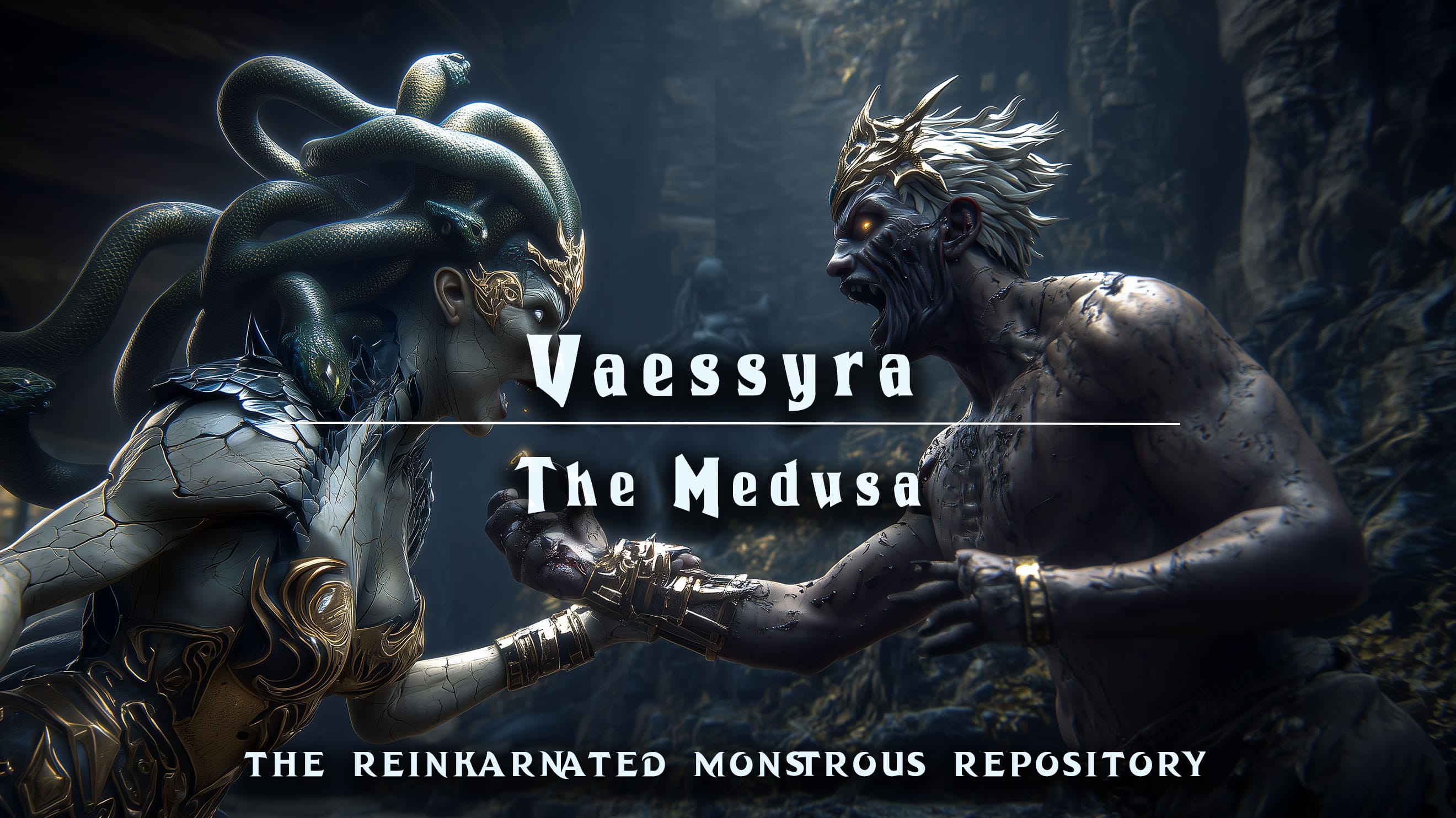
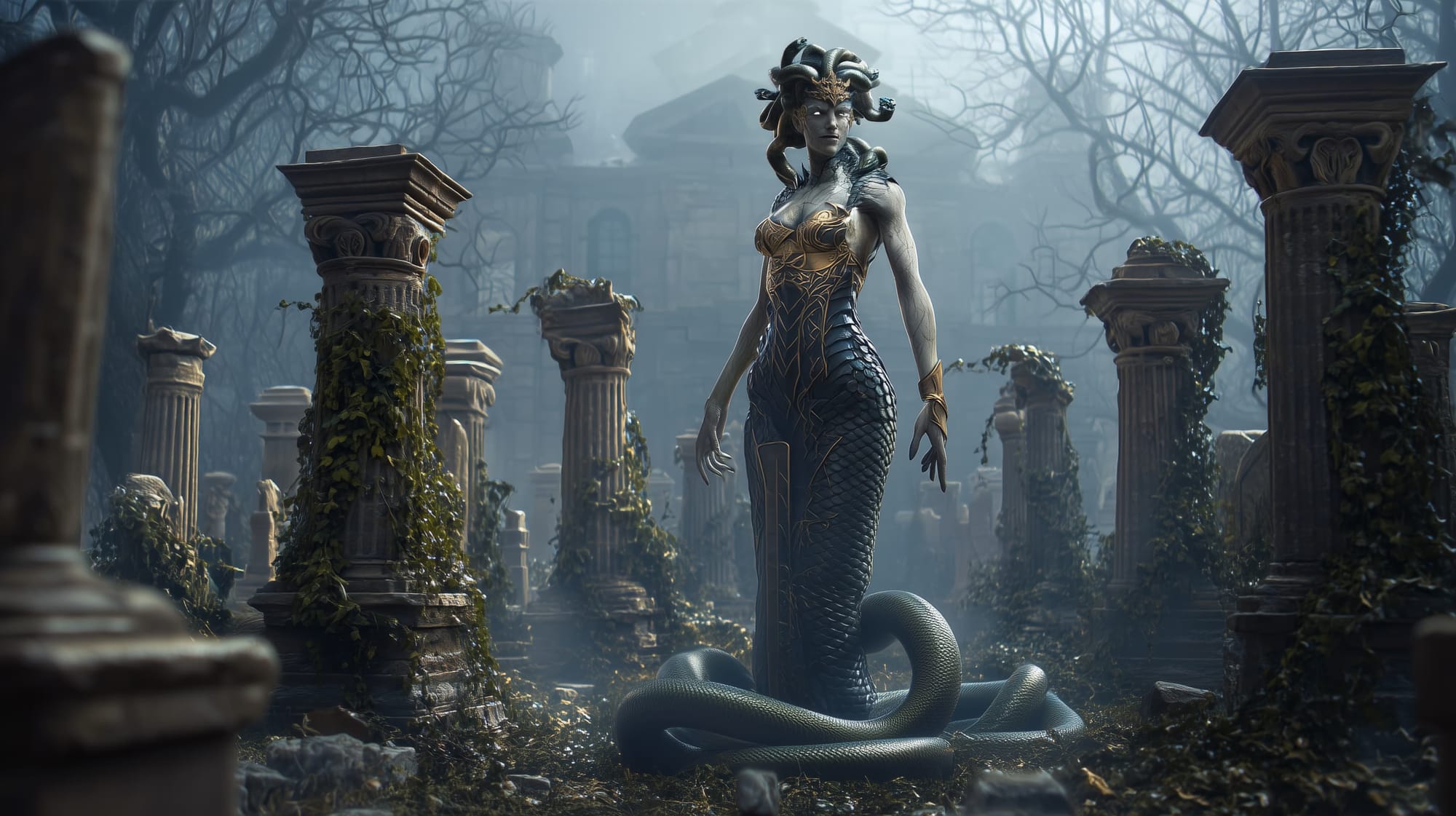
Vaessyra’s upper body is that of a statuesque woman with ash-pale skin veined faintly like marble. Her movements are unnervingly smooth, almost sculptural, as though she is already halfway petrified herself. Fine cracks trace her arms and collarbone, evidence of ancient curses slowly claiming her body.
Where her hair should be coils a crown of serpents—thick-bodied, stone-scaled vipers with dull gemstone eyes. They move slowly, deliberately, hissing not in anger but in warning, mirroring Vaessyra’s own restrained demeanor.
Her lower body tapers into a powerful serpentine tail, its scales dark green and gray, polished smooth by centuries of stillness and stone dust. Her eyes—when revealed—are luminous silver, reflective as mirrors. Those who meet her gaze often report seeing themselves reflected not as they are, but as they fear becoming.
Backstory:
Vaessyra was once a magistrate in a fallen city-state obsessed with legacy and appearance. When corruption hollowed the courts, she alone continued passing sentences that powerful figures refused to accept. Her refusal to look away—literally and metaphorically—earned her divine punishment twisted into curse.
Transformed into a medusa, Vaessyra fled into ruin, expecting madness or rage to consume her. Instead, she found clarity. The curse did not strip her of justice—it made justice absolute.
Over centuries, she refined her role, abandoning vengeance for judgment. She no longer seeks to punish the innocent or the ignorant. She petrifies those who choose to be remembered wrongly, preserving them exactly as they were when they refused to change.